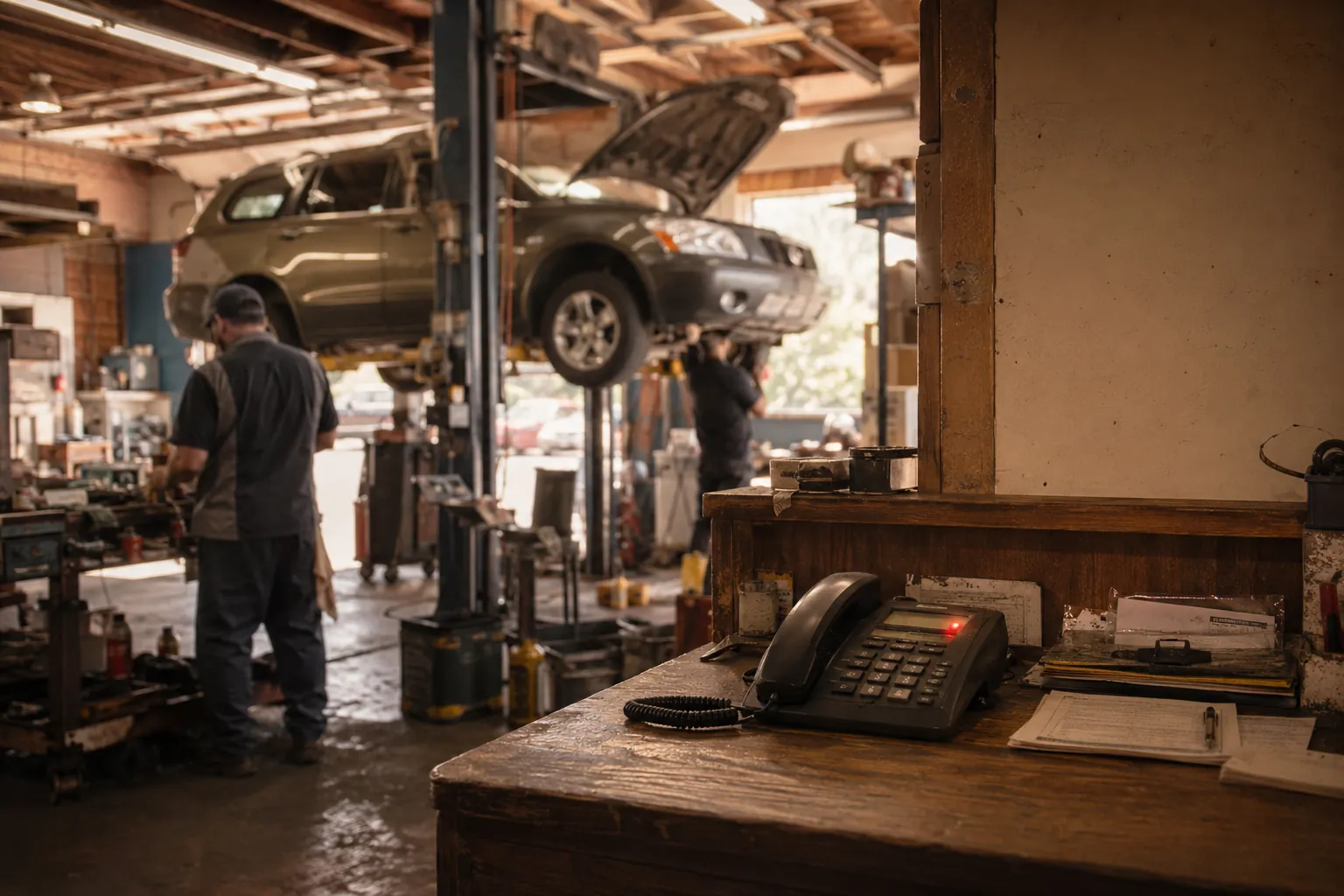
The car is on the lift. You are elbow-deep in it. The phone goes off up front. It is a customer asking if their car is ready yet.
You wipe your hands. You walk over. You check. You tell them another hour. You walk back, find your place, and pick the job up again. Then it rings once more.
That call, is my car ready, comes in over and over all day. By itself it costs you a minute. The problem is it never comes by itself. It comes again and again, mixed in with appointment reminders and estimate phone tag, and together they grind the bay to a crawl.
Why a small call costs you a big chunk of the day
The shop-software maker Shopmonkey put the pattern plainly. Pausing to answer the phone, reminding customers of their appointments, and playing phone tag to get estimates approved, they write, “can be incredibly disruptive and slow down productivity.” That is their framing, not a hard number, but any owner who has lived it knows it is true.
The cost is not the minute on the phone. It is the restart. You lose your place under the hood. A torque sequence gets interrupted. A tech breaks focus on a job he was about to finish. Do that a dozen times before lunch and you have lost an hour, maybe more. And most of those calls told the customer nothing a quick text could not have.
And your time is the scarce thing here. Eric Reich, who bought Bennett’s Automotive, learned that fast. “As a shop owner, you have to be careful about your time,” he told Tekmetric. The status call quietly steals it, one pickup at a time.
The call that hides behind all the others
Here is the real damage. When the phone is buzzing all day with people checking on cars, the calls that actually grow the shop get buried in the same noise.
A new customer with a check engine light. Someone asking if you can get them in today. A brake job ready to book. These are the calls that pay for the bay. But to your front desk they sound like every other ring, and when you are under a car you cannot tell the difference until you stop and answer. Sometimes you do not stop. Then that one walks.
For an independent, a walked caller rarely waits around. They dial the next shop on Google. Chris Shamis, who owns Dakota Ridge Auto, watched it happen. A fumbled or missed call, he told Ratchet+Wrench, and “next thing you know, you’ve lost that opportunity with that customer.” The routine status calls make that easier to do, because they train you to half-listen.
What one missed new job is worth
It helps to put a price on the call you drop. A single new customer lost in the phone noise is not a small thing. It is most of a typical repair order, gone, while you were busy telling someone else their car was ready.
Shamis tied it straight to trust. People “buy from people they trust,” he said, and “if they don’t trust you, they’re not going to agree to a $500 repair.” You cannot build that trust on a call you never got to. The same trust is on the line when a caller asks what a brake job runs and you blurt a number, which we get into in why you should not quote prices over the phone. Margins are thin in this trade, so every job that slips off the board stings.
Why you cannot just put it on the calendar yourself
The easy answer sounds like self-service. Let customers check their own status, book their own slot, and leave you alone. It does not work for auto repair, and owners know why.
Lucky Sing, who runs Lucky’s Auto Repair, said it best in an UpFlip interview. “You can’t let customers book their own appointment because they don’t know how long it will take. So we have our customer manager Rich approve it or contact them.” A car is not a haircut. Every job needs a human to size it up. That is exactly why a raw booking widget on your site falls short, a point we go into in why customers cannot self-book auto repair.
So you are stuck. You need a human touch on every real job, but you cannot afford to keep a human glued to the phone for the routine stuff. That gap is where the day gets eaten.
Clear the routine, catch the leads
The way out is to split the two kinds of call. The routine status check gets handled the second it lands. The real new job gets caught and sent to you with everything you need to act. That is owning the inbound you already earn, which beats paying for cold leads, a trade-off we lay out in paid ads versus owning your inbound.
That is the job SvarKlar does, and it can do it for your shop. It replies to texts, web-form leads, and direct messages in seconds, around the clock. When someone calls and you cannot pick up, it texts that caller right back. A quick is-my-car-ready turns into a fast, useful reply instead of you crossing the shop with greasy hands. We get into the grease-and-phone problem in phone coverage when your hands are full.
Here is how it works. SvarKlar answers in text. A status check gets a fast, calm reply that confirms you have their car and will update them shortly. The real status answer, the part only you know, comes to you with the customer’s name and vehicle already attached. You reply once, by text, when you step away from the car. When a lead is urgent or unclear, it hands the job to you with the full context, so nothing important hides behind a routine ping. If you want the whole walkthrough, see how SvarKlar works.
Why this is not just another bot
You have a fair worry here, and you should. People are wary of being handed to a machine, and most would rather deal with a person. A cheap bot that guesses a price or fumbles a car it does not understand can do more harm than a missed call. The setup is what makes the difference.
SvarKlar is built per shop by Fred, by hand, and he runs it himself. It is not big software you fight with for months. It is set up around how your shop works, the questions you ask, the way you book. The routine stuff it handles cleanly. The judgment calls go to you. For the wider picture of how a setup like this fits a service business, the AI receptionist guide covers it.
The goal is plain. Get the is-my-car-ready calls off your back so the bay keeps moving, and make sure the call that books a real repair never gets lost in the buzz again.
Your time is the one thing the shop cannot make more of. Give the status checks somewhere to go and you stop paying for them in lost hours and dropped jobs.
Want to see how it would handle your shop’s calls? Book a call or see how the service works.
More guides like this are collected in our auto repair resources.