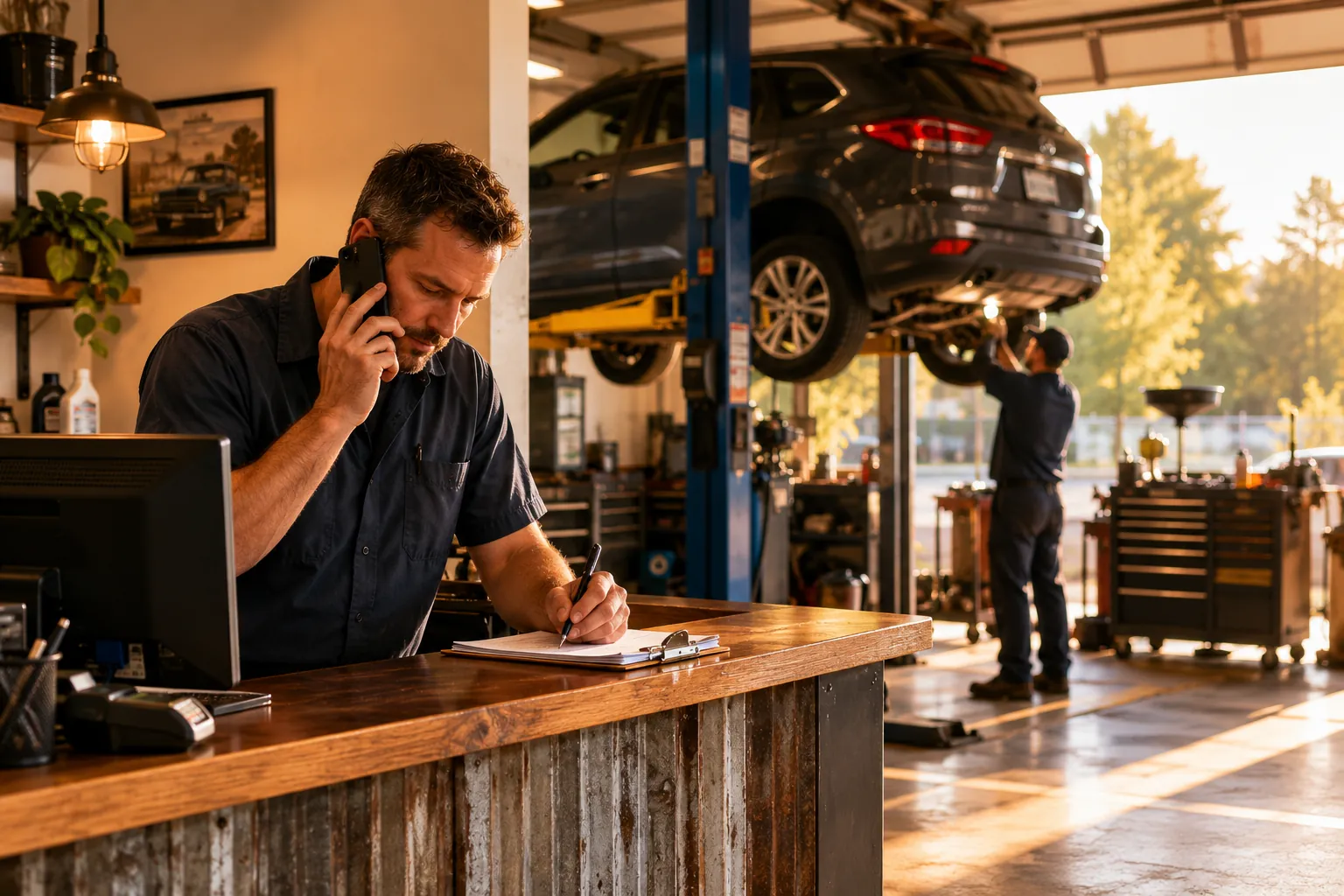
The phone rings while you are elbow-deep in a transmission. You wipe a hand, pick up, and the first words are “how much for brakes?” No make. No model. No idea if it is pads, rotors, or a caliper that is hanging on by a thread. Just a number, please, and fast.
Every shop owner knows this caller. The instinct is to blurt out a figure so you can get back to work. That instinct loses jobs.
Why a blind quote works against you
When you blurt out a price over the phone, you do one thing. You turn the whole conversation into a number. Now the caller has your figure. They call the next shop, get theirs, and book whoever said the smaller one. You just gave a competitor the price to beat.
And the number is probably wrong anyway. Brake pads swing widely depending on the car and the parts. You have not seen the rotors. You do not know if the caller drives a small commuter or a loaded truck. Guess low and you eat the difference or look like a liar when the real bill lands. Guess high and they hang up before you finish the sentence.
There is a deeper problem here too. Owners who play the price game attract the customers who only care about price. One shop owner on The Garage Journal forum put it plainly: “Don't get known as a shop that discounts, price matches or plays the low price game. You will lose time, energy and your patience dealing with those customers.” A phone quote is the front door to exactly that crowd.
The call is the sale, not the price
Here is what the best shops understand. The phone call is not a step before the sale. It is the sale.
Todd Hayes runs operations at Adams Automotive in Houston. He says it about as directly as it gets to Ratchet+Wrench: “How you represent your company over the phone determines whether or not they'll buy from you.” That is not because his shop wins a race to the lowest number. It is because they handle the call well.
Chris Shamis, who owns Dakota Ridge Auto outside Denver, ties it straight to trust in a separate Ratchet+Wrench piece. “People buy from people they trust. If they don't trust you, they're not going to agree to a $500 repair.” A blurted-out price builds zero trust. A good conversation builds all of it.
That matters because the typical job is not small. It is usually a full repair order, not pocket change. You do not protect a job that size by reading a number off the top of your head while you are busy.
What to say to the price shopper instead
You do not have to dodge the question. Dodging reads as hiding, and that loses trust just as fast as a bad number. The move is to be honest about the range, then pivot to the car.
Something like this works:
- Give the honest range. “A brake job usually falls in a fair range for pads, but it depends on what we find.” Now you sound fair, not cagey.
- Name the unknown. “I can't promise a final price without seeing the rotors and the calipers. A wrong guess over the phone helps neither of us.”
- Book the look. “Bring it by, we'll check it free and give you a firm number before we touch anything.”
That last line is the whole point. You traded a guess for an appointment. The car is now coming in, and once it is on your lift, you are not competing with the shop down the road anymore. You are the shop they chose.
The real problem is who answers the call
None of this matters if the phone goes to voicemail. And in a shop where everyone turns wrenches, it often does. The person who should answer is usually the person under a car. You cannot give a thoughtful range and book the visit if nobody picks up.
Shamis described the cost of that better than anyone. “They might say, 'OK, I'll call you back,' and next thing you know, you've lost that opportunity with that customer.” The price shopper does not wait. They dial the next name on Google and ask the same question there.
So the price-quote problem and the missed-call problem are the same problem. Both come down to whether someone gives a fast, smart answer when a stranger asks what it costs. We dig into the coverage side in how shops answer the phone with greasy hands and in the cost of missed calls.
Where SvarKlar fits the price-shopper call
SvarKlar catches the price shopper on the channels they also use, the text and the web form, and it catches them in seconds.
When someone texts the shop, fills out a web form, or sends a message asking “how much for brakes?”, SvarKlar replies right away, day or night. The range comes back in your words, not a robotic dump. It asks the make and model, then steers the chat toward booking the look instead of naming a final price. If the caller hits your voicemail, SvarKlar texts them back before they reach the next shop.
When a question gets tricky, or the job sounds urgent, it hands the lead straight to you with the full context already gathered. No guessing at a price it has no business quoting. That is the line a good front desk holds, and the line a cheap bot blows through.
If you want the bigger picture of how this works across your whole inbound, see the AI receptionist for service businesses and how SvarKlar works. For why a fast first reply wins the price shopper, read how fast to reply to leads.
The honest bottom line
Should you quote prices over the phone? Give a fair range, never a final number on a car you have not seen. Use the call to earn the visit, because the visit is where the trust and the real job live.
And make sure the call gets answered at all. A price shopper who reaches a fast, honest answer often becomes the customer who tells a neighbor. Most people lean on friends and family when they pick a repair shop. Independents live on that word of mouth. Lose the price call and you lose more than the one job. You lose the next three people that caller would have sent you. For more on plugging those leaks, the rest of our guides for auto repair shops dig into each one.
The shops that win the price shopper do not win on the lowest number. They win on a fast, honest answer and a booked visit. The car on your lift is worth far more than the figure you almost read off the top of your head.
Want to see how SvarKlar would handle your price-shopper texts and missed callers? Book a call or see how the service works.