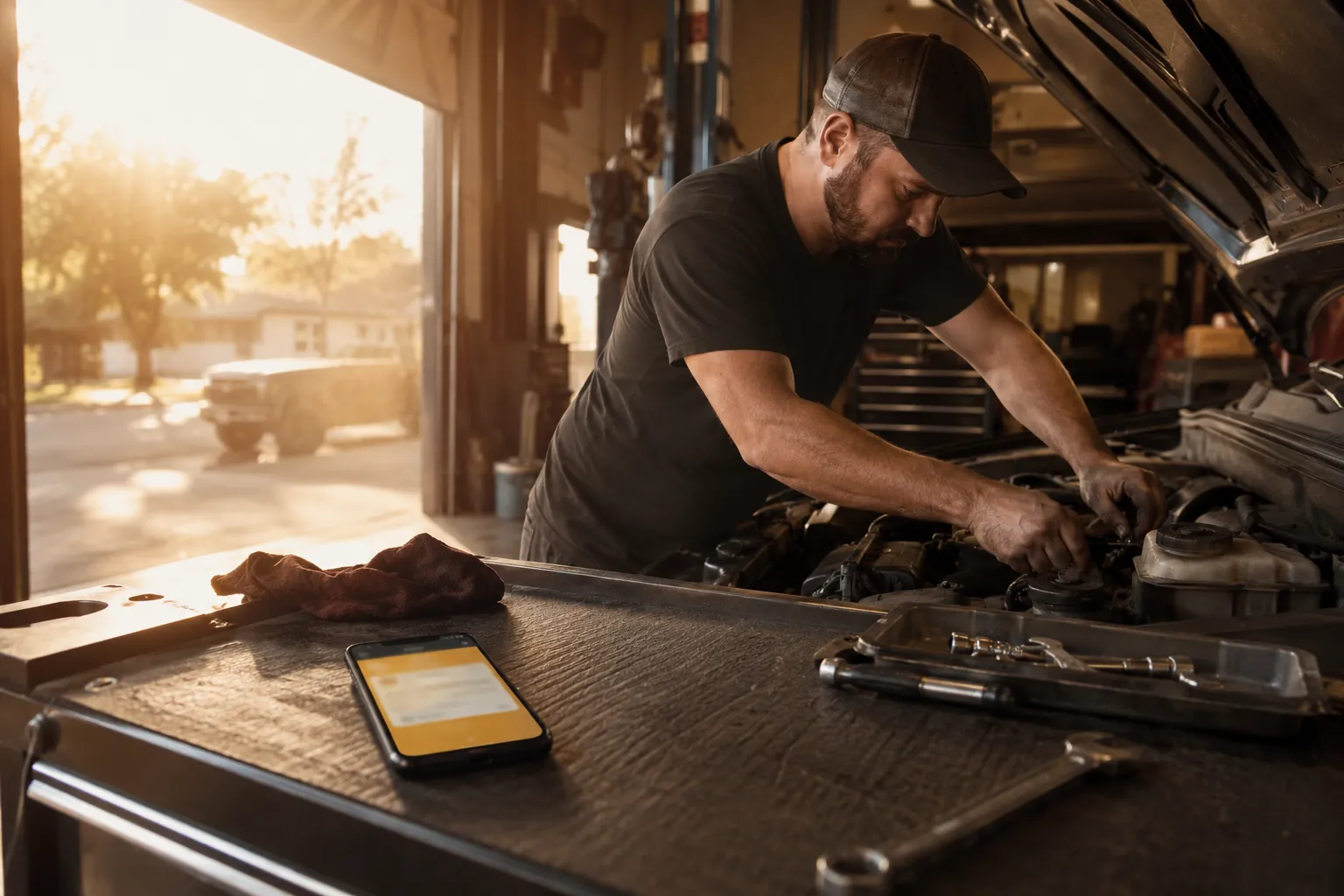
A request comes in. "Can I book Tuesday at 9 for my brakes?" Sounds easy. Say yes.
But you do not know yet if it is a pad slap or a seized caliper and a rusted line. One is an hour. One eats your whole morning. Slot it at 9 like a dentist appointment and you have just broken your own day, or made a promise you cannot keep.
This is the quiet reason self-serve booking never quite works for a shop. A car is not a haircut. The job has no fixed length until someone asks what is wrong.
Why a booking page lies to your calendar
Online booking tools love a tidy grid. Pick a day, pick a time, done. That works when every job is the same size. Yours never are.
Lucky Sing, who owns Lucky's Auto Repair, put the problem plainly in an UpFlip owner interview. "With auto repairs, you can't let customers book their own appointment because they don't know how long it will take. So we have our customer manager Rich approve it or contact them." That is the whole thing in two sentences. The customer cannot size the job, so a human reads it, sizes it, and approves the time.
Drop that step and the calendar fills with guesses. A 9 AM that should have been a 90-minute block. A "quick look" that turns into a tow and a parts wait. Every wrong slot pushes the next car back and turns a good day into an apology tour.
So someone has to qualify every car
Qualifying is not red tape. It is the part that protects your day and the customer's trust. A few questions sort it out fast.
- What is the car? Year, make, model. You cannot block time for work you may not even take.
- What is it doing? A grinding noise, a check engine light, a dead start. The symptom sets the size.
- How urgent? Drivable and can wait, or stranded and needs in today.
Answer those three and a vague "book me Tuesday" turns into a job you can actually plan around. Skip them and you are scheduling blind.
The trouble is who has to ask. In a one or two bay shop, the person who should be on the phone is the person under the car. You cannot stop a brake job to text back about a brake job. So the qualifying does not happen, and the request sits.
And the request will not sit there waiting
A customer who reaches out does not wait politely for a callback. They are already comparing shops. If you go quiet, they move on.
Chris Shamis, who owns Dakota Ridge Auto, has watched it happen on the phone. "When you have people calling in and asking questions that you don't give a consistent answer to... they might say, 'OK, I'll call you back,' and next thing you know, you've lost that opportunity with that customer," he told Ratchet+Wrench. It is the same for a text or a web form that nobody answers. Silence reads as a no.
And the volume is real. Plenty of calls to a busy shop go unanswered during business hours, for the simple reason that the bays are full and nobody is free to pick up. A lot of work is knocking while you are turning a wrench.
What each missed request is actually worth
It helps to put a number on the thing you are dropping. One booking request is usually one repair order.
A single unqualified, un-booked request is not loose change. It is usually a full repair order, walking to the shop down the road.
Shamis ties it straight to trust. "Answering a phone correctly should be the easiest way to gain new customers. People buy from people they trust. If they don't trust you, they're not going to agree to a $500 repair." A request that gets a fast, sharp reply builds that trust. One that gets voicemail does the opposite.
Margins make it sting more. In this trade they run thin, so every job you let slip is one you needed. We put the wider math on dropped leads in the cost of missed calls.
The fix is not a booking widget. It is a fast first reply.
If self-serve cannot size the job, the answer is not a slicker calendar. It is something that does the qualifying step the second a request lands, then hands the sized job to you.
Here is how it works. SvarKlar answers in writing, by text, web form, and direct message, around the clock. Miss a call, and it texts that caller right back in seconds.
Say that "book me Tuesday" lands while you are at the bay. SvarKlar replies in seconds. The customer hears back right away, day or night, before they scroll to the next shop on Google. It asks the three questions that size the job: what is the car, what is it doing, how urgent. Then it acts on the answer. A clear job goes on the calendar. A fuzzy one comes to you to approve, with everything it learned attached.
So the customer never hits a dead calendar slot that guesses wrong. They get a real reply and the right questions, fast. You get a job you can say yes to instead of a mystery in the inbox. For the wider picture of how this works across a service shop, start with how an AI receptionist works for service shops.
It keeps the human approval Lucky described
This is the key part, so read it slow. SvarKlar keeps the approval step yours. It just does the legwork in front of it.
Lucky's shop has Rich read a request and approve it or call the customer. SvarKlar plays Rich's first move. It greets the customer in seconds, asks what is wrong, and gathers the facts. Then it either books the clear job or brings the rest to you to approve, the same call Rich makes, now with the questions already answered.
You stay the one who says yes to the tricky time slots. You just stop being the one who has to ask the first round of questions from under a hood. More on the qualify-then-approve flow in what an AI receptionist actually does.
It knows when not to guess
Sizing a job has a limit, and a good system respects it. SvarKlar reads a confusing message for exactly what it is.
If a car sounds urgent or the details do not add up, it hands the whole thing to you with the questions it asked and the answers it got, instead of forcing it into a random slot. You make the call on the odd ones. A stranded customer who needs in today is never quietly booked for next Thursday.
It keeps its promises honest too. It tells a customer you will take a look, not that the car can be done by five before anyone has seen it. It gathers the facts, holds the lead, and gets it to you. We dig into that sort-the-real-urgency work in why status-check calls eat the day.
The after-hours request is the one self-serve drops hardest
A dead start at 9 PM. A grinding noise on a Saturday. These come in when the shop is dark and nobody is reading the inbox.
A self-book page would happily slot that car for a time you have not approved, or leave the customer staring at a form with no reply. Either way you lose the read on it. SvarKlar is already awake. The late request gets the same calm questions it would get at noon. It pulls the facts, books the clear ones, and flags the rest so the job is on your list at sunrise instead of gone by it.
Qualifying is not quoting a price
One thing this step should never turn into is a phone price. Asking what is wrong with the car is not the same as putting a dollar figure on it before anyone has looked.
SvarKlar holds that line the way you would. It finds out what the car is and how urgent the job is, then sets up the visit, instead of guessing a brake number on a car nobody has seen. We cover that whole trap in why you should not quote auto repair prices over the phone.
Stop letting an empty inbox approve your jobs
Right now, when a request lands and nobody is free, the inbox makes the call. It sits on the job. It lets the customer drift. That is an approval too, just the wrong one, made by silence.
You can take that step back without growing a third arm or hiring a Rich of your own. The fix is something that replies the second you cannot, asks what sizes the job, and brings you a clean one to approve. New to the idea? The full set of auto repair guides lives on the auto repair resource hub.
The car still cannot size its own job. That part never changes. What changes is the wait. The request gets a reply in seconds and the three questions that size it, so what reaches you is one clean call: book it, skip it, or look closer. That is one less brake job walking to the shop down the road.
Want to see how it would handle your booking requests? Book a call and we will walk through where jobs slip away before you ever see them. You can also read what we handle on the homepage.
More guides like this are collected in SvarKlar Resources.