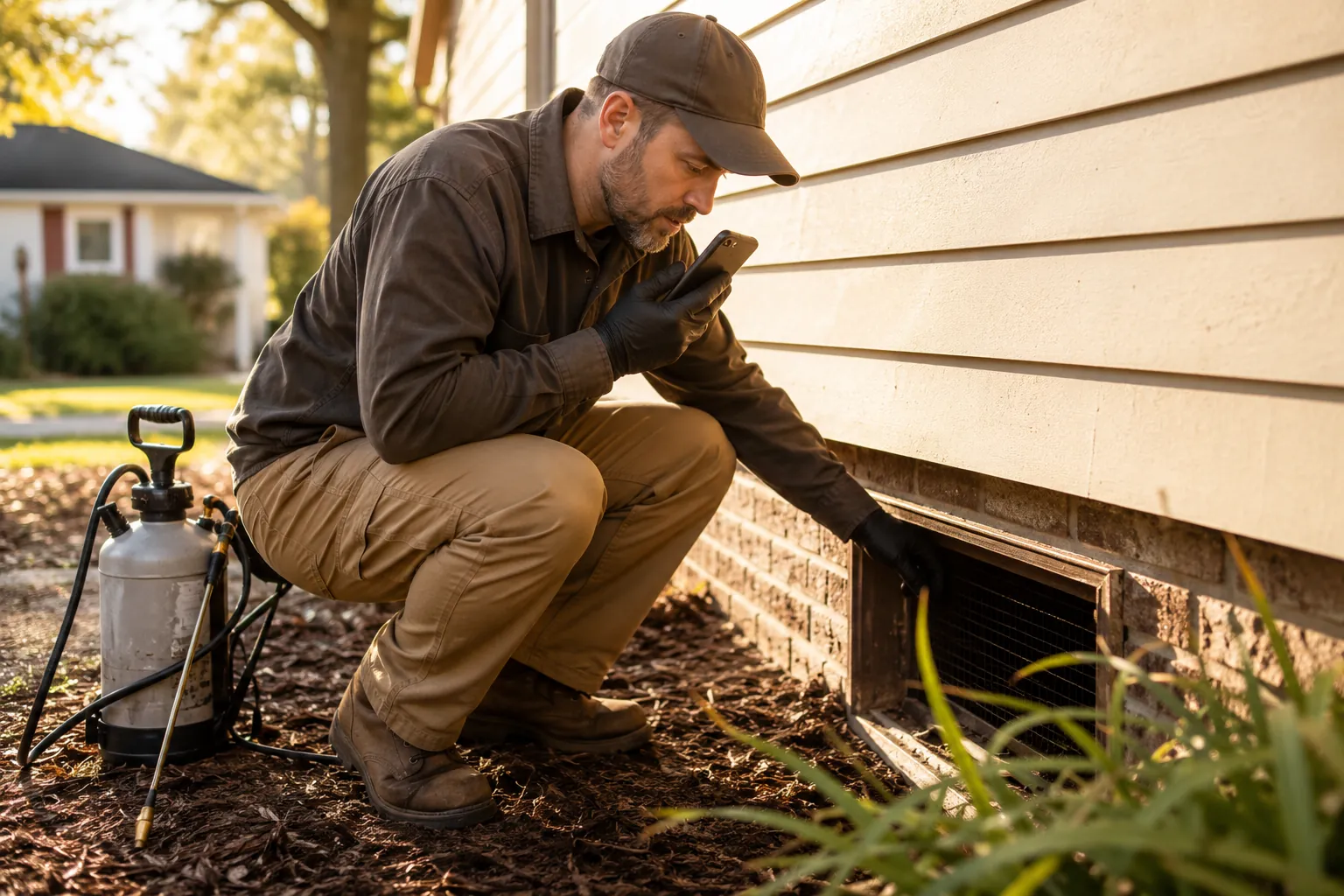
The phone rings while you are halfway under a house. The caller wants one thing fast. “How much to get rid of the bugs?” You have not seen the bugs. No address, no clue if it is two ants on a counter or a colony eating a porch. And they want a number right now.
Give one, and you are guessing. Guess high and the real job walks. Guess low and you eat the cost when you show up and the job is three times what you thought. The price you say on the phone is the trap. The fix is simple. Ask a few questions before any number leaves your mouth.
Why one price never fits a pest job
Pest control is not one service at one rate. It is a dozen jobs that happen to share a phone number. A single roach treatment takes an afternoon. A termite remediation can run for days and carries real risk if you call it wrong. Same trade, different planet.
The spread is wide. A one-time ant spray sits at the low end. A full termite job can run many times that. A standalone roach job, a bed bug treatment, a real inspection fee, each lands somewhere in between. The bands move by region and by how bad the problem is. So treat any number in your head as a ballpark, not a fixed rate.
Here is what that means for you. A number that is fair for an ant spray is an insult on a termite job. A number that covers termites scares off the person with one wasp nest. There is no safe single price to read off the phone. The only honest answer is the one you give after you know what you are dealing with.
The questions that turn a call into a quote
You do not need a long script. You need four things before you talk money. Most callers will give them in under a minute if you ask plainly.
- What is the pest? Ants, roaches, rats, wasps, bed bugs, termites. The pest sets the whole job. “Bugs” is not an answer you can price.
- Where is the property? The address tells you the drive, whether it is in your area, and what kind of build you are walking into.
- How bad is it? One nest by a door or a wall full of them. Saw one mouse or hearing them in the attic every night. Severity is most of the price.
- What is the access? Crawlspace, attic, slab, two stories. A job you can reach standing up is not the job you do flat on your back under a house.
With those four, you can give a real range or set a free inspection. Without them, you are pricing a job you have never seen. Jeremy Logsdon, who started Preventive Pest Control in Houston in 2002, put the lesson plainly: “It's never too early to create effective systems.” Four questions, asked every time, is that system for the phone.
Range or inspection, not a hard number
Even after the questions, resist the urge to lock a price sight unseen. A phone quote is a guess dressed up as a number. The wall behind the cabinet might be worse than they think. The one nest might be five.
Two safer plays. Give a range tied to what you heard, and say the on-site look sets the real figure. Or offer a free inspection, which is what a lot of pest customers are already searching for. Either way you are honest, and you have a reason to be standing in front of the work before money changes hands. Erin Richardson, a third-generation owner at All-American Pest Control, framed the goal as “make it easy to do business with you.” A clear range and a quick path to a look is easy. A guessed number you walk back later is not.
The hard part: you cannot ask when your hands are full
All of this assumes you can answer. Most days you cannot. You are under a house, in an attic, mid-treatment with a sprayer in your hand. The call rings out and goes to voicemail, and the questions never get asked.
That is the real squeeze, and owners know it. Josh Davis of Neighbors Pest Solutions described his early days like this: “I spent five months as a service technician working from sunup to sundown while Derek took office calls until 10 p.m.” One person in the field, one person buried in the phone. Most solo owners do not have a Derek. The phone just rings out.
And the panicked caller usually will not leave a message. Most who reach a recording just hang up. So the lead is gone before you ever get to ask what the pest was. It gets worse in bug season, when the calls stack up faster than one person can field; we cover that in surviving the bug-season call surge. We dig into the on-the-job version of this in handling leads while you are under a house, and the after-hours version in after-hours and emergency pest calls.
How SvarKlar gets the facts without the phone
This is the gap SvarKlar fills. It is the front desk for your inbound work, what we call The Receptionist. When a text, a web form, or a direct message comes in, it replies in seconds, day or night. When a caller hits your voicemail, it texts that caller right back. It works the lead in writing, gathering what you need while your hands are still full.
And it asks the four questions for you. The pest, the address, the severity, the access. By the time you wipe off your hands and look at your phone, the lead is not a blank “how much?” voicemail. It is a job with the facts already gathered, so you can quote a real range or book the inspection. Some leads it flags straight to you. A wasp nest by a front door. A caller who sounds shaky on the details. Those land with the full context, so you can step in fast.
It never guesses a price it should not. It does not promise a tech today if that is not true. It gathers what you need to quote, then hands it over clean. For the wider picture of how this works across your whole inbound, see the AI receptionist for service businesses and how SvarKlar works.
How SvarKlar is built
This is not big software you fight with for six months. Fred builds it for your shop by hand and runs it himself. It asks the questions your trade actually needs, in your voice, set up around how you book and what you flag. One person on the hook for it, not a faceless platform.
If you are weighing this against buying leads, that is a different question with its own answer. We cover it in SvarKlar versus paid pest leads. The short version: this catches the leads you already paid to attract, instead of selling you the same contact your rivals already called.
The number you say on the phone is only as good as what you knew when you said it. Get the pest, the address, the severity, and the access first. Then quote a range or set the inspection. That one habit keeps you from scaring off real work or eating the cost of a lowball.
Want every caller asked those questions, even the ones you miss while your hands are full? Book a call or see how the service works.
More guides like this are collected in our pest control resources.