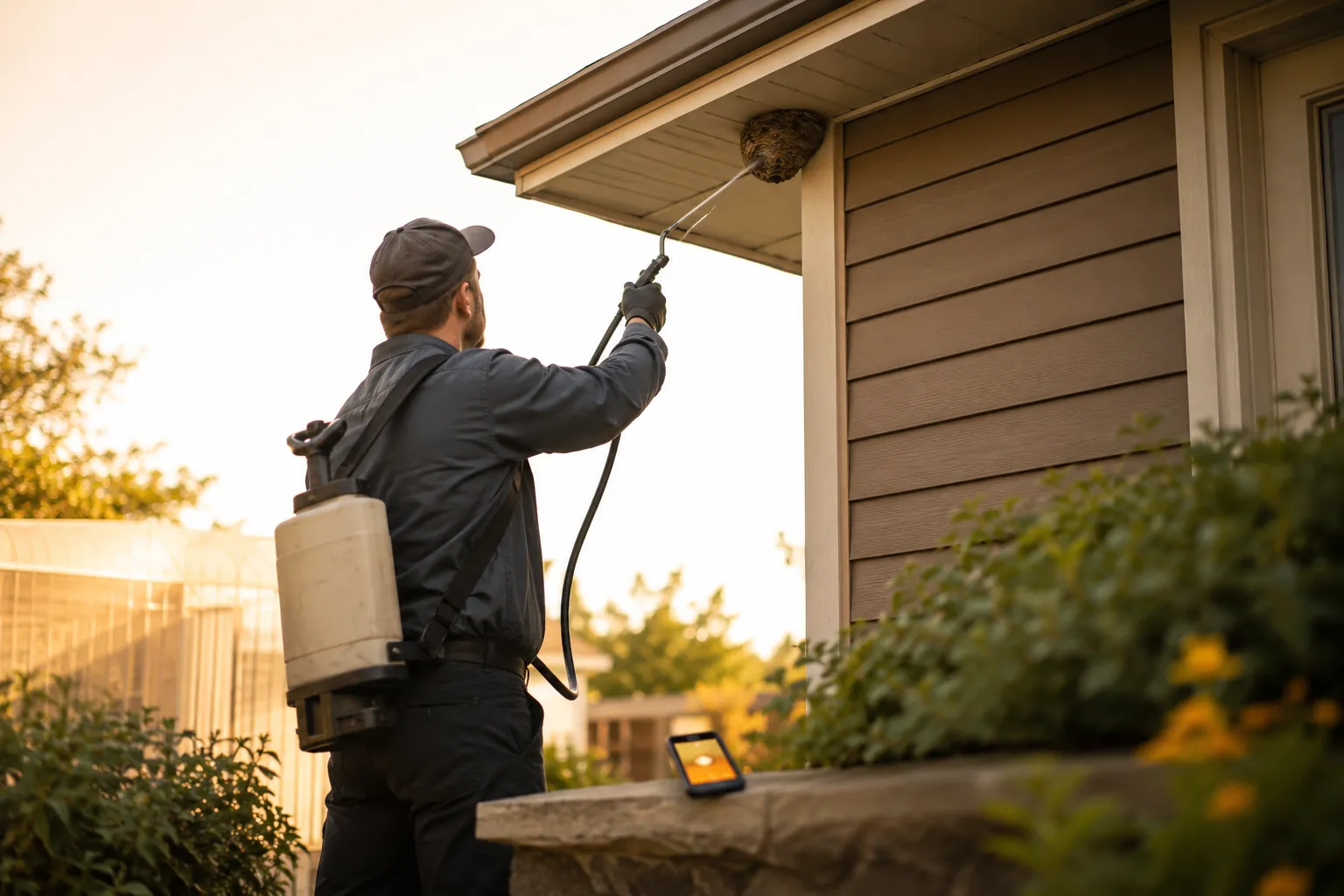
It is July. Ninety degrees. You are on a ladder under an eave, knocking down a wasp nest while the homeowner watches. Your phone buzzes in your pocket. You cannot reach for it. By the time you are off the ladder and washed up, there are three missed calls and no voicemails.
That is bug season for a one-person shop. The work that pays the bills all year shows up in the same few months, and it all needs you in the field. The calls and the jobs arrive at the exact same time, and you only have one set of hands.
Why summer breaks the solo operator
The slow winter is easy. You answer every call yourself because there are not many. Then spring hits and the bugs wake up. Ants, wasps, termites swarming, the first roach call of the year. The phone that barely rang in January will not stop in July.
By one vendor's count, calls can double or triple. Same one person to take them. Something has to give, and it is usually the phone, because the phone is the thing you cannot do while you are already on a job.
Josh Davis, who co-founded Neighbors Pest Solutions, lived the split most owners know. As he told Authority Magazine: “I spent five months as a service technician working from sunup to sundown while Derek took office calls until 10 p.m.” That is two people, and the phone still ran one of them into the night. A solo owner does both jobs alone.
And the season carries the year. In Davis’s words, he dedicates himself “to servicing almost every new customer gained during our busy April to August sales season,” and he “met 1,500 customers face to face over that span of time.” Every one of them started as a call or a form that someone had to catch first.
The lead does not wait for your callback
A pest caller is rarely calm. There are rats in the kitchen. A nest by the front door where the kids walk. Bed bugs found at midnight. These people are in a small panic, and a panicked person does not leave a voicemail and sit tight. They call the next company on the list.
You do not need a number to feel it. Most callers who reach a recording will not leave a message. They hang up and move on to the next pest control name on the list. The busier the season, the more of those you miss.
You do not need the exact figure to feel it. In summer you miss more calls than any other time of year, and the ones you miss are the ones most likely to book someone else. Speed is the whole game, and we get into the real targets in how fast to reply to leads.
What that surge actually costs you
A missed summer call is not one lost spray. Pest work is repeat work. The roach job in June can become a quarterly plan, and the recurring contract is where the real money sits. One steady quarterly customer dwarfs a single visit, because it pays out for years.
So when a call slips during the surge, you are not out one treatment. You may be out years of that customer, plus the neighbor they would have told. We walk through that math in the cost of missed calls, and the number lands harder than most owners guess.
Now count the misses. Summer is the one stretch where the most leads and the most dropped calls hit at once. The roach call you grabbed in winter, you let ring in July because you were under a house. Each one that rings out is a quarterly account that booked someone else.
You cannot just hire your way out of it
The obvious answer is to put someone on the phone. For a few peak months, that rarely pencils out. You are hiring and training a person right when you are busiest, for a window that closes in August. A human still steps away, still sleeps, still misses the 9 PM emergency. And the after-hours surcharge jobs are often the best ones you get.
Jeremy Logsdon of Preventive Pest Control learned the lesson the slow way: “It’s never too early to create effective systems.” A system, not another warm body, is what carries a one-person shop through the months that try to break it.
How SvarKlar holds the line through bug season
SvarKlar is that system for your inbound. When a lead texts you or fills out your web form, it replies in seconds, day or night, all summer. Miss a call while you are spraying a yard, and it texts that caller right back before they dial the next company.
It asks what your trade needs. What is the pest, where is it, how bad, how fast. A wasp nest by a door is not the same as a one-time ant spray, and it sorts the urgent from the routine. Then it books the job on your calendar or sets a clear callback time. Anything urgent or unclear goes straight to you with the full picture, not a guess.
Here is exactly how it works. SvarKlar handles your inbound in writing. It replies to texts, web forms, and direct messages in seconds, and it texts back the callers you could not reach. For a solo operator buried in summer field work, that is most of the leak, caught.
And it is not big software you fight with for six months. Fred builds it for your shop by hand and runs it himself, set up around how you book and what you charge. That is the underdog version: one person on the hook for it, not a faceless platform. You can read the full walk-through in how SvarKlar works, or the broader idea in the AI receptionist guide.
The other summer pressures, handled
The surge feeds into the rest of the season, and we cover the whole picture in the pest control resources hub. The surge is not the only thing pressing on you in July. Callers want a price before they will book, and quoting blind is a trap. We cover that in giving a price over the phone. The best-paying jobs land at night and on weekends, and those go straight to voicemail unless something catches them, which is the whole point of after-hours emergency leads.
And if you are still buying leads to fill the season, it is worth doing the math on whether that pays. One contractor, in a review of a paid-lead platform, reported getting “10 leads, only two of which were legitimate,” from a customer who had already “contacted four competitors first.” SvarKlar is the opposite play. It answers the leads you already paid Google to send you, instead of chasing a name your rivals already bought. We lay it out in SvarKlar versus paid leads.
Make it through the surge, not just survive it
Bug season is the part of the year that decides how good your year is. The leads are there. The recurring contracts are there. The only question is whether they reach you while your hands are full, or land in your competitor's calendar instead.
You will never spray a yard and answer the phone at the same time. You do not have to. A reply that fires in seconds, every time, on every text and form, is how a one-person shop keeps the season's work without working past dark.
Want to see how it would handle your summer inbound? Book a call or see how the service works.
More guides like this are collected in SvarKlar Resources.