
Opening a lawn care business comes down to four choices in a set order: what you sell, what you buy first, how you set up and insure the company, and how the first lawns find you. Each step below rests on a page read in November 2026, and owners speak where they said it in public. Insurance and license prices change with where you work, so this page gives none. Hiring a crew is outside it.
Start with the lawns, then add landscaping
TriGreen Equipment, a John Deere dealer, tells new owners in a May 2026 post: “Many operators start with lawn care and add landscaping services over time as cash flow improves, experience grows and operators are added.” The same post asks you to settle two things first, residential or commercial work, and whether you will work alone or with a crew. It says the answers decide your equipment, your pricing and your marketing. Write both down before you shop, because a one-person route of weekly mows needs a different list than a crew doing patios.
Lawn care business startup costs: a list you can price
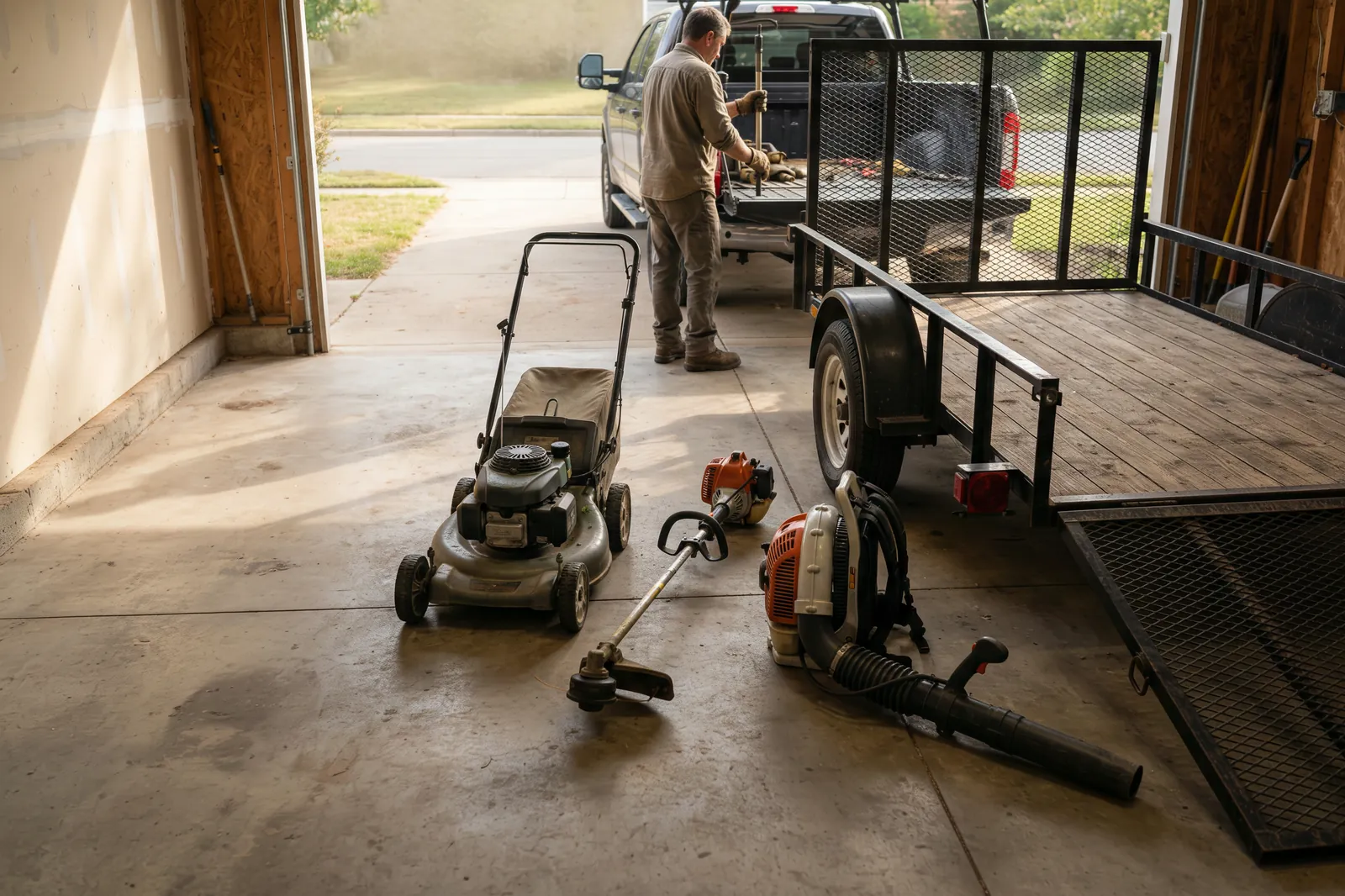
Neither of the two guides that rank beside this one gives a number you can budget on. Shopify’s lawn care guide says costs run from “a few hundred dollars if you already own lawn care equipment and a reliable form of transportation, like a truck, to thousands of dollars for a commercial lawn mower and a trailer to transport it.” TriGreen says costs vary so much that an estimate would be “likely inaccurate”. A method works better than a guess. UpFlip’s landscaping guide lists what each tool costs, and these are the ones a one-person mowing route needs, as of November 2026:
- Push mower: $200 to $1,000
- Trimmer: $50 to $300
- Edger: $80 to $350
- Leaf blower: $100 to $500
- Trailer: $1,500 to $5,000
- Heavy-duty truck: $10,000 to $50,000
Adding the first four gives $430 to $2,150. Adding the trailer takes it to $1,930 to $7,150. That is our arithmetic on UpFlip’s ranges, not a market average. UpFlip’s own pages disagree on the average: the landscaping guide puts it at “between $15,000 and $20,000 if you’re starting from scratch”, while its lawn care guide says “The average lawn care company has $7,000 in startup costs”. Neither shows how it got the number. Mike Andes, who founded Augusta Lawn Care, told UpFlip: “When we started, we started with $1,000 to buy a blower, a weed eater, and a lawn mower.” UpFlip adds that you can rent equipment from home improvement stores “typically for around $100/day”.
It is a seasonal trade too, and UpFlip says “don’t forget to plan for reduced cash flow during the winter months.” Keep some of the money you start with back for that.
Buy the tool the job needs, or the one that lasts
Two ways of buying pull in opposite directions. Brian Linson of BL Landscapes told UpFlip: “We buy the tools we need for the job, and when you sign another job you take some of that money and buy the tool you need for that job, and that way you just keep building up.” TriGreen, which sells equipment, says many new owners make their first costly mistake by “buying equipment that can’t keep up once the workload increases”. It adds that residential-grade tools “wear out faster, break during peak season, and slow productivity”.
You can use both. Buy what the first signed lawns need, then replace the machine that breaks first with a commercial one. Think through one question before you pick: what does a dead mower cost you on a day with eight stops booked? A commenter on r/lawncare wrote that if you want to make money landscaping, “you will need service/repairs and the local dealership will be able to help you”, so ask a dealer near you whether they repair what they sell.
Set up the company and insure the work
The U.S. Small Business Administration’s launch guide says costs that “can vary significantly by location include standard salaries, minimum wage laws, property values, rental rates, business insurance rates, utilities, and government licenses and fees.” The guide’s checklist runs in this order: choose a structure, choose a name, register, get tax ID numbers, apply for licenses and permits, open a business bank account, get business insurance. For the federal tax number, the IRS says “You never have to pay a fee for an EIN.”
Insurance matters on a lawn route because you work on other people’s property. UpFlip says “Potential customers expect landscaping companies to be insured to cover job sites if they damage something while on the job.” Ask an insurance agent what a one-person mowing business needs. Licenses, pesticide permits and business registration differ by state, so check your own state’s rules before you take the first job.
Price each stop so the lawn pays you
Rob Palmer, who founded Lawn Squad, told UpFlip: “We aim for 25% profit margins.” That is one franchise founder’s aim, not a market figure, but it shows what to work toward: price a stop to leave something after fuel, line, repairs, insurance and your own pay, not only to beat the next quote. Another commenter on r/lawncare gave a route rule: “Get as many customers as possible in one parking location. You’re only making money when you’re cutting. Driving time costs money and time.” So time a stop from the moment you park, add the drive to it, and price the lawn from that number.
A third commenter in that thread wrote: “I give clients a detailed list of what they can expect each service and let them know that anything out of the regular will be an extra fee.” Put the same lines on paper before the first mow. The landscaping estimate template has lines for lawn areas, beds and weekly visits, and the route-rule commenter ends on the money: “make sure you get paid! If customers don’t follow through, drop them!”
Where the first lawns come from
TriGreen lists what early success tends to come from: “Clean, professional-looking equipment”, “Yard signs and neighborhood visibility”, a “Google Business Profile presence”, “Before-and-after photos” and “Word-of-mouth referrals”. The last two need a finished job first, so begin with the customer next door. The route-rule commenter says to “Knock on the doors of surrounding customers and get their business too. Offer new customers a deal if they get additional neighbors to give you business.” That keeps your stops on one street. The guide on how to get more landscaping jobs takes the cheapest sources in order once you have a few weeks of work behind you, and the local marketing playbook has more ways to get known.
New customers also send the questions that decide a price, such as the address, the size of the lawn and how soon. The landscaping quote checklist lists them.
When the phone rings while you are mowing
A new business has few calls to miss, so you may not need help with the phone yet. When the calls do start arriving while you are on the mower, SvarKlar answers calls with AI, texts back missed callers and answers texts and forms in seconds, any hour. What it costs is on AI receptionist pricing.
Opening a lawn care business can begin on a few hundred dollars of tools, with the rest bought as signed lawns pay for it. Put your own prices on UpFlip’s list, check your state’s rules, insure the work and start on the street where the first customer lives.
To see what happens to the calls once your route fills up, book a call or see how the service works.
More guides on the Landscaping and lawn care answering service page sit in this section, and the rest of the library is at SvarKlar Resources.