
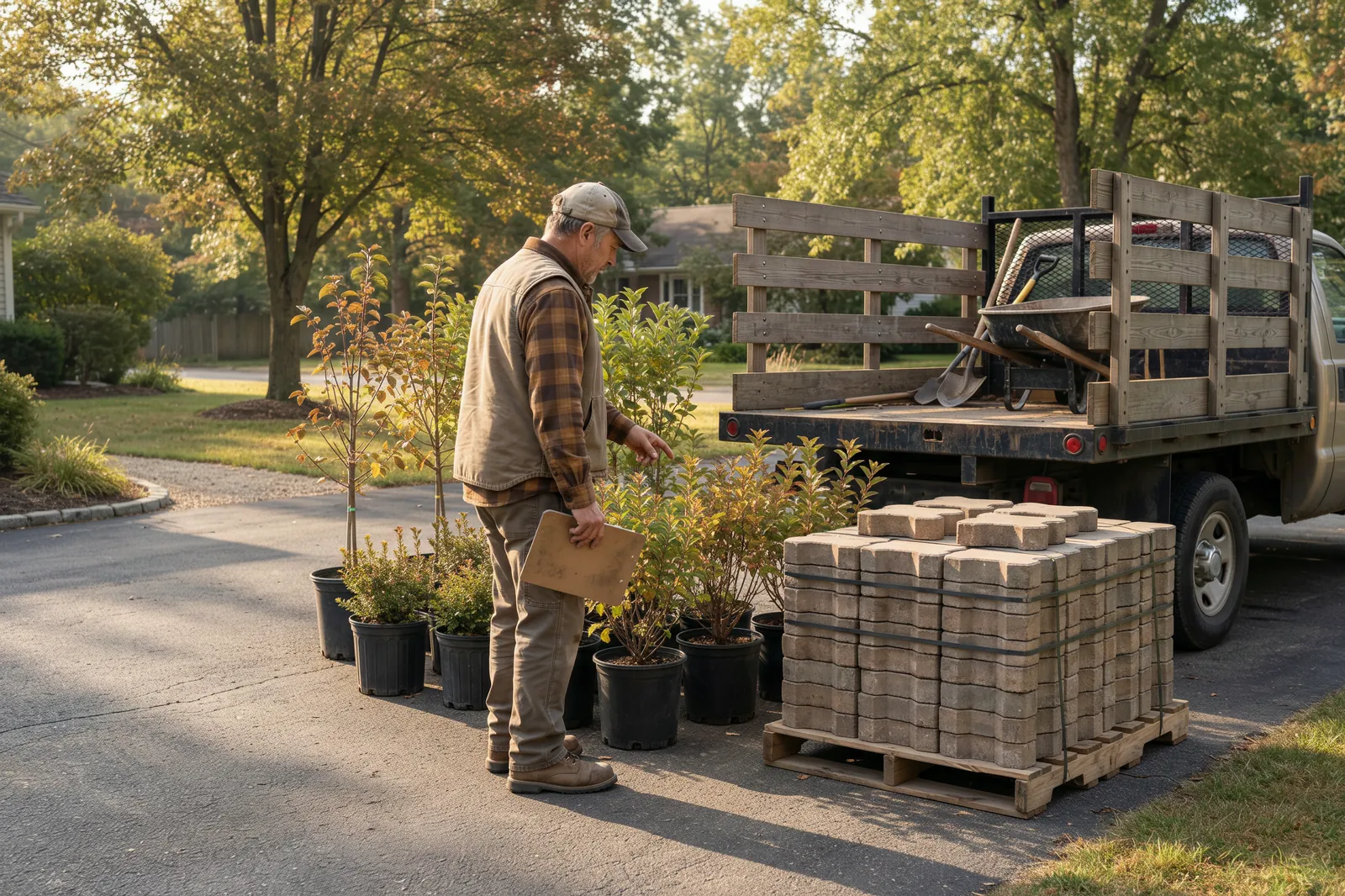
This landscaping estimate template fits on one sheet, so it goes on a clipboard for the site visit and comes back to the truck filled in. The Word file takes your logo and can be typed into and sent; the PDF prints as it is. Neither asks for an email address.
Most landscape prices rest on three things you can only get on site: how big each area is, what goes into it, and how long the crew will be there. The form has a block for each, in the order you walk a yard.
This page and its files are general information, not legal advice. Laws differ by state and change, so check your own state’s current rules before you use the form. Terms for free content.
The template, line by line
“Ours” marks a line we put there because a landscape job goes better with it. “Texas” marks a line that a Texas rule quoted further down asks of an estimate for irrigation work.
| Field | On the line | Why it is there |
|---|---|---|
| Company and customer | ||
| Company name, phone, business address, license number | Your details, or your logo at the top | The customer knows who priced the job, and on a sprinkler job the Texas rule asks for the business address and phone (Texas). |
| Licensed irrigator name, irrigator license number | Filled in only when the job installs or repairs a sprinkler system | The person who holds the irrigation license may not be the owner (Texas). |
| Property address; gate, access and pets | Where the work is, and how the crew gets in | A locked side gate or a dog in the yard costs a crew time on the first morning (ours). |
| Sprinkler heads and lines marked? | Yes or no | Edging, trenching and planting cut lines that nobody flagged (ours). |
| The site | ||
| Lawn, bed and hardscape area | Square feet of each | Sod, seed, mulch, fabric and pavers are all bought by area, so the price can be traced back to a number (ours). |
| Slope and drainage; sun or shade | A few words for each | A slope slows the crew, standing water changes the bed, and shade changes which plants you list (ours). |
| Haul-away | Cubic yards of old sod, soil or brush | Removal is real work and a dump fee, and it is the line most often left out (ours). |
| Work and price | ||
| Description of the work | Two lines in plain words | The customer reads what they are buying before they read a number (ours). |
| Plants and materials | Quantity, plant or material with its size, unit price, line total | A 1-gallon shrub and a 5-gallon shrub are different prices, so the size sits next to the name (ours). |
| Labor and equipment | The work, crew hours, rate, line total | Machine time, such as a skid steer or a sod cutter, can sit on its own row (ours). |
| Delivery and disposal, sales tax, total price | The extra charges and the one figure to approve | Nothing is hidden inside the total (ours). |
| Upkeep price per visit | Your price for each mowing or maintenance visit after the install | A new bed or lawn often turns into weekly work, and the customer sees that price before saying yes (ours). |
| Terms and approval | ||
| Start date, estimated completion date | When the crew comes and when it is done | Planting windows and weather move jobs, so both dates are written down (ours). |
| Advance deposit, progress payment and stage of work | Each amount and the point in the job it is due | Plants and stone are bought before the crew arrives (ours). California has a limit on a downpayment, quoted below. |
| Estimate good until, plant warranty | A date, and what the warranty covers and for how long | Nursery prices change by the season, and a plant that dies in June is easier to settle when the terms were written in April (ours). |
| Signatures and dates | Under the printed approval sentence | It shows the customer approved this price before the work began (ours). |
How to estimate a landscaping job with this form
Walk the yard with a measuring wheel and fill in the site block first. Write each area as you go: the lawn you will reseed, the bed you will rebuild, the patio you will lay. Note the slope, any wet ground and whether the beds face the sun.
Then turn the areas into a list. A bed of a known size tells you how much fabric and mulch to buy, and the plan tells you how many plants of which size. Each one goes on its own row with your price, so a customer who wants to cut the budget can see which rows to drop.
Labor comes next. Count crew hours for each part of the job, add machine time where you rent or run equipment, and put the delivery of stone or soil and the haul-away of old material on their own lines. The form gives the method, not the rates; this page gives no market number, because your costs and your area set them.
If the request is vague, you may not need the walk at all for a simple mow, and you will for anything you build. Our landscaping quote checklist sorts the two before you drive out.
One install, then the weekly visits
A landscaping estimate often prices two things at once: the project, paid once, and the upkeep that starts after it. The form keeps them apart. The total price is the install. The upkeep price per visit is a separate figure, so the customer is not surprised by a mowing bill in the first week, and you have a written start for the recurring work.
Repeat work is where a landscaping business gets steady, and our guide on paid leads or repeat work covers why.
What we found in California, Texas, Florida and New York
State rules differ, and most of the texts we read for landscaping speak of the signed contract, not the estimate. Each quote below is copied word for word, with the paper it speaks of and when it applies. The form has a signature line under its approval sentence. We claim nothing beyond what each text says, and no line on this form is a promise about what a law asks. If you work in another state, or a town with its own rules, read the wording at the source.
California, Business and Professions Code and Title 16
California’s text ties a bid to the license. Business and Professions Code section 7026 says who counts as a contractor, and that includes anyone who submits a bid. The words are from the state’s own page for section 7026, checked there November 23, 2026. Within that chapter, it says, “a contractor is any person who undertakes to or offers to undertake to, or purports to have the capacity to undertake to, or submits a bid to, or does himself or herself or by or through others, construct, alter, repair, add to, subtract from, improve, move, wreck or demolish any building, highway, road, parking facility, railroad, excavation or other structure, project, development or improvement, or to do any part thereof”. We list it because its words include submitting a bid.
The license class for landscape work is set in Title 16 of the California Code of Regulations, section 832.27, Class C-27 Landscaping Contractor. The words are from the state’s own page, checked there November 23, 2026. It says “A landscape contractor constructs, maintains, repairs, installs, or subcontracts the development of landscape systems and facilities for public and private gardens and other areas which are designed to aesthetically, architecturally, horticulturally, or functionally improve the grounds within or surrounding a structure or a tract or plot of land.”
Section 7151 defines home improvement on a residence, and its list names landscaping. Section 7151.2 defines the home improvement contract. Section 7159 applies when a licensed contractor, or one who must be licensed, contracts with an owner or tenant for home improvement on a residence for more than $500. Section 7030 covers every licensee’s written prime contract, and section 7030.5 covers every licensee.
On a deposit, section 7159.5 speaks of any home improvement contract with a licensed contractor, or one who must be licensed: “If a downpayment will be charged, the downpayment shall not exceed one thousand dollars ($1,000) or 10 percent of the contract amount, whichever amount is less.” The form’s Advance deposit line has no limit written on it, so a California landscaper reads that text before writing an amount there.
Two of these texts meet on a small job. Section 7026 reaches anyone who submits a bid, and section 7048 is the minor work exemption: under $1,000 with no permit, the chapter does not apply. Section 7048 has limits we do not quote here, so read both before you treat a small job as outside these rules.
Texas, Administrative Code Title 30 and Business and Commerce Code
In Texas, the rules we read for landscaping reach only sprinkler work. They are the Texas Commission on Environmental Quality’s rules for irrigators, and the words below are from the state’s own text of each rule, a file its site makes on request, checked November 23, 2026. Section 344.1 (the state’s rule text) says which landscape work is irrigation services: “(20) Irrigation services--All activities involving an irrigation system including, selling, designing, installing, maintaining, altering, repairing, servicing, permitting, consulting services, or connecting an irrigation system to a water supply.”
Section 344.71 (the state’s rule text) applies when you install or repair an irrigation system, not to mowing, planting or other landscape work. It speaks of the estimate: “All written estimates, proposals, bids, and invoices relating to the installation or repair of an irrigation system(s) must include the irrigator's name, license number, business address, current business telephone number(s), and the statement:” The statement is ““Irrigation in Texas is regulated by the Texas Commission on Environmental Quality (TCEQ) (MC-235), P.O. Box 13087, Austin, Texas 78711-3087. TCEQ's website is: www.tceq.texas.gov.”” The form has lines for the irrigator’s name and license number, and the Company lines hold the address and phone. The form does not print the statement; its irrigation heading tells you to add it.
The same section speaks of the signed contract in (a): “All contracts to install an irrigation system must be in writing and signed by each party and must specify the irrigator's name, license number, business address, current business telephone numbers, the date that each party signed the agreement, the total agreed price, and must contain the statement,” and that statement is ““Irrigation in Texas is regulated by the Texas Commission on Environmental Quality (TCEQ), MC-235, P.O. Box 13087, Austin, Texas 78711-3087. TCEQ's website is: www.tceq.texas.gov.”” The two statements differ by one pair of parentheses, so each goes in its own place. In (d): “The contract must include the dates that the warranty is valid.” This form does not carry the contract’s statement. Advertising for irrigation services has its own rule, section 344.70.
Business and Commerce Code chapter 601 applies when the seller solicits the sale in person away from its place of business and the customer agrees away from it, for goods or services over $25. We found and read no statewide Texas rule on the estimate for planting, mowing, mulching or hardscape.
Florida, chapter 489 and chapter 713
We found no Florida rule on what a landscaping estimate holds, and the part of chapter 489 we read does not name landscaping. Statute 489.103 exempts small jobs from the contractor licensing part: “Any work or operation of a casual, minor, or inconsequential nature in which the aggregate contract price for labor, materials, and all other items is less than $2,500, but this exemption does not apply:” and the exceptions follow in the statute, so read them there. The text we read does not settle whether landscape work is contracting under chapter 489.
Statute 489.127 applies when anyone advertises as available to act as a contractor, or acts as one, without being registered or certified under chapter 489. Statute 713.015 applies to a direct contract over $2,500 between an owner and a contractor for improvements to real property of one to four dwelling units. The text we read does not say whether landscaping is an improvement under chapter 713.
New York, General Business Law and Environmental Conservation Law
New York’s texts name the signed contract. General Business Law section 770 defines home improvement, and its list names landscaping. It reaches residential work by a contractor whose home improvement contracts total over $1,500 in 12 months, where the contract price is over $500. Section 771 applies to a home improvement contract as section 770 defines it. The parts we read do not name an estimate or a bid. Lawn pesticide work has its own text: Environmental Conservation Law section 33-1001 applies to a commercial lawn application of pesticide and speaks of a written contract.
These texts speak of the signed contract, and this form does not carry the notices and headings they ask for. The texts we read do not say whether a signed estimate is the contract they speak of.
When the estimate request comes in mid-mow
The form helps once you are standing in the yard. The job can be lost before that: a homeowner calls about a new patio while you are on the mower, gets voicemail, and calls the next company on the list. What missed calls cost puts a number on it, and how fast to reply to leads shows why the first reply counts. Our missed call text back for landscaping guide has sample texts for a route day.
When you miss the call, SvarKlar texts the caller back within seconds. It asks for the address and what they want done, which are the first lines of this form, and passes the thread to you. The estimate stays yours to write; SvarKlar quotes only from your own price list, and only when you want that. What it costs is on the AI receptionist pricing page, and the rest of the trade is on our landscaping and lawn care answering service page.
Print a stack, measure the next yard with the site block, and the price you hand over will show the area, the plants and the hours it rests on.
Want to see how SvarKlar would answer the people who ask you for an estimate? Book a call or see how the service works.