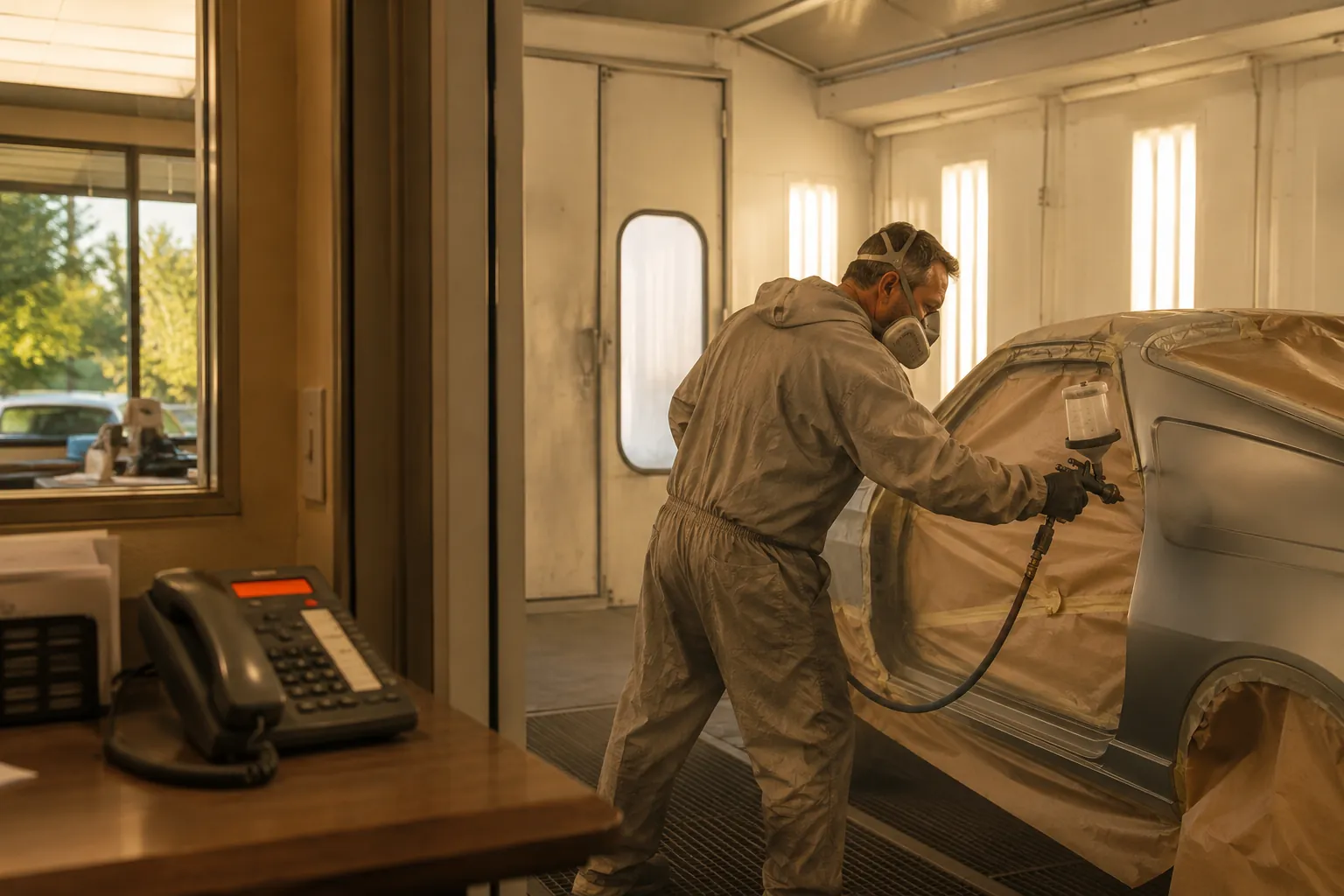
You are in the booth, respirator on, a quarter panel half coated. Or you are under a car on the lift, both hands up in a wheel well. The phone rings up front. You cannot stop. So it rings out, and you tell yourself you will call back once this dries.
By the time you are free, the driver has dropped the car at the shop down the road. That is the trap in one moment. Not your price. Not your work. You lost the body because you were busy fixing one, and there was no one else there to pick up.
Why one owner is the whole problem
In a one or two bay shop, you are everything. The painter, the estimator, the parts chaser, the bookkeeper. The work that pays you needs both hands, your eyes, and your full head. And that is exactly when the phone goes off, because that is when you are out earning.
The collision trade is built on owners like this. The BodyShop Leaders Podcast tells the story of Tim Paap, who opened Paap Auto Body as a one-man shop in Mattoon, Illinois, painting cars after hours to save money and bootstrapping every dollar. Every hat worn at once. When you wear every hat, the ringing phone is the one hat nobody is holding.
Ask around the trade and they all say the same thing. One shop owner's first tip to a new operator on Reddit was blunt: “Make sure the phone gets answered every time it rings with a friendly voice, even if it’s a PITA caller.” Simple advice. Harder to follow when both hands are already in a wheel well.
The receptionist is out of reach
The obvious fix is to put a person up front so you stay on the panel. For a one-bay shop, the cost is the wall you hit.
A front-desk hire is a real wage, plus benefits and taxes on top, paid every month whether the bay is busy or not. You do not need an exact figure to feel it. That is a heavy thing for one bay to carry.
And here is what makes it heavier. Body-shop money is lumpy. Work runs hot and cold, and the slow stretches pay less. So you would be signing up for a fixed salary against an income that swings. In a good month it stings. In a slow month it can sink you.
There is a quieter problem too. A hire does not actually close the gap. They take lunch, they go home at five, they step out to the parts store. The phone rings the same in all those minutes. You would pay a full wage and still miss the call that came in while they were away from the desk.
And buying leads does not fix it
Some owners skip the hire and try to buy their way out with a lead platform instead. Buying more leads while you still cannot answer them is pouring water into a bucket with a hole in it. The lead you paid for rings out the same as the one you did not.
It can also be money straight down a hole. Owners in other trades tell the same story: the same lead sold to several pros at once, and plenty of names that never turn into a real job. The warning travels. We weigh the trade in paid leads versus owning your inbound. The first fix is not more leads. It is catching the ones you already have.
First to answer takes the body
Most drivers do not call one shop and wait. They just got in a wreck, they are rattled, and they work down the Google list until someone answers. Most people whose call goes unanswered do not call back. They move on to the next shop. Whoever picks up first usually gets the body. The rest of you find out later you lost work you never knew came in.
That is why a single missed call hurts so much in collision. A body in your bay is a real repair ticket, not a coffee order. Miss the call and the whole ticket walks to the shop down the road.
Speed is the entire game. We dig into the real targets in how fast to reply to leads. The short version is plain. Minutes beat hours. Seconds beat minutes. As a one-owner shop in the booth, you cannot win that race with your hands full.
Catch the lead without a second person
This is the gap SvarKlar fills. It watches your inbound and answers the second a lead lands, while you stay on the car. It works like a front desk for your texts, web forms, and messages, with none of the payroll.
Here is what it does. SvarKlar texts back the callers you miss, and it answers your text, web-form, and direct-message leads in seconds, day or night. It catches the lead in writing, fast, then either books it or hands it to you with the full story.
- Texts back missed callers. The call rings out, and SvarKlar sends that caller a real text in seconds, so the conversation starts instead of dying in voicemail.
- Answers texts, web forms, and messages 24/7. A text, a contact form, a message off your site. None of them sit waiting for you to be free.
- Asks the right questions. What was hit, the year, make, and model, whether insurance is in play. You start warm, not cold.
- Books the easy ones. A clear estimate goes on the calendar without you touching it.
- Hands you the hard ones. Anything urgent or unclear comes straight to you with the full story already gathered.
You get the coverage of a front desk without the payroll. No salary to carry through the slow months. No second person who still misses the call when they step out. For the wider picture, see what an AI receptionist does for a service business and how SvarKlar works.
The callback you never get to make
The trap has a second half. Even when you mean to call back, the booth eats the time, and the promise slips. The driver does not wait around for it.
Owners see it play out the same way. A customer is told they will get a call back, the day gets away, and by the time anyone remembers, that driver has booked elsewhere. That is a body and a referral, gone, because the callback lived in your head and not in anyone's hands.
Flip it around and the callback is free money. Plenty of owners win work just by doing the one thing most shops never do: actually calling the missed caller back. The bar is that low. SvarKlar keeps the thread alive so a warm lead does not go cold while you finish the panel. More on that in no callback, no job.
“But my customers hate talking to a robot”
Fair worry, and you should have it. Your callers just had a wreck. The last thing they want is a bot guessing at a price and making a bad day worse.
So the honest goal is simple. SvarKlar is upfront that it is an assistant, and it sticks to what is true about your shop and your timing. A fast, useful text beats a voicemail nobody returns. When the lead is urgent or odd, you step in. The bar is not “sound human.” The bar is “catch the job and tell the truth.”
Drivers want two answers fast: what is the next step, and roughly what will it cost. You do not want to quote a hard price on a car you have not seen. SvarKlar can ask the qualifying questions and give an honest sense of cost without painting you into a corner. We walk through exactly how in handling price questions before the driver calls the next shop.
Built by one person, for a one-person shop
SvarKlar is not big software you fight with for six months. Fred builds it for your shop by hand and runs it himself. It is set up around how your bay works: the questions you ask, the way you book estimates, the jobs you want flagged to you. That is the underdog version of this. One person on the hook for it, not a faceless platform that signs you up and goes quiet.
If your week looks like a phone you cannot reach and no one else to grab it, answering faster is not the cure. You are already at your limit in the booth. What changes the week is a lead that gets caught whether or not you are free to catch it.
You are one owner with one pair of hands. As long as the work that pays you is the work that takes both, the phone will keep ringing at the worst moment. You cannot be quicker than you already are with a panel half coated. So put something between that ringing phone and the lead, so the next wreck down the road does not end up in the bay across town.
Want to see how SvarKlar would catch your inbound while you work? Book a call or see how the service works.
More guides like this are collected in collision repair and auto body resources.