
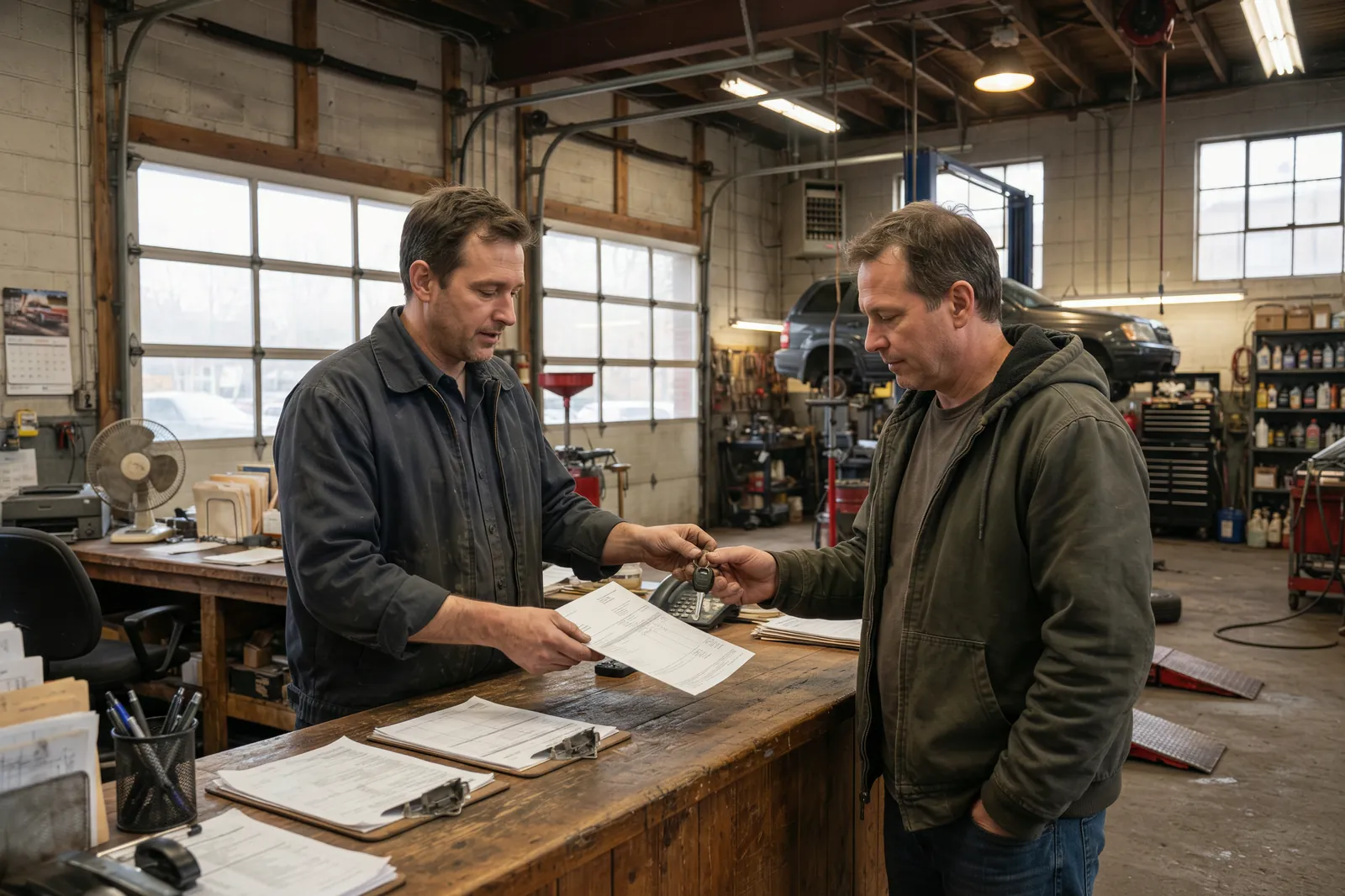
An auto repair invoice template saves you from building the bill from scratch after every job. Both files above download as they are, with nothing to sign up for. Put your logo in the box and print the PDF, or fill in the Word file on screen.
This page and its files are general information, not legal advice. Laws differ by state and change, so check your own state’s current rules before you use the form. Terms for free content.
An invoice is not an estimate
The estimate comes first and the invoice comes last. If you still need the first one, our auto repair estimate template is the form for before the work starts. This page is the bill for after it.
| Estimate | Invoice | |
|---|---|---|
| When you write it | Before any work starts | When the repair is finished |
| What the numbers are | What you expect the job to cost | What the job did cost |
| What the customer does with it | Approves it, or says no | Checks it against the estimate and pays |
The two can share a form. Florida says so: “The invoice may be provided on the same form as the written repair estimate”. Most shops still keep them apart, so the customer can see the price they agreed to next to the price they were charged.
The template, field by field
Read the table across: the field, what you write on it, and the reason it earns a place. A state name in brackets means the text quoted further down asks for that item. For the total on the estimate, the text is Minnesota’s 110 percent rule. “Ours” means we added it, and no quoted text asks for it.
| Field | On the line | Why it is there |
|---|---|---|
| Shop | ||
| Shop name and address | Your name and street address, or the logo box | The invoice names the shop that did the work (California and New York). |
| Shop phone | The number customers call | A customer with a question about the bill knows who to call (ours). |
| Shop registration or license number | The number your state gave the shop | The state’s own text lists it on the invoice (Florida, California and New York). |
| Invoice number | Any running number | A question about one bill is easy to find later (ours). |
| Invoice date | The day you wrote it | It dates the bill to the completed repair (Florida and New York). |
| Date of repair | The day the repair was done | It can differ from the day you wrote the bill (Minnesota). |
| Customer and vehicle | ||
| Customer name, phone, address | The person who owes the money | The bill says who it is for, and you can reach them if a question comes up (New York). |
| Year, make, model | The car as the registration shows it | The bill names the car the work was done on (New York). |
| VIN | The 17 characters at the base of the windshield | It singles out one car even when the plate changes. New York asks for the plate number, the VIN or both (New York). |
| License plate | The plate number | It records which car you handed back (New York). |
| Odometer when brought in | Mileage when the customer handed the car over | It records the reading when the car was presented for repairs (Minnesota). |
| Odometer at pickup | Mileage when the car goes back | It records how far the car had gone when the work was done (Florida and New York). |
| Work, parts and labor | ||
| Symptoms the customer described | The problem in the customer’s own words | The bill says what the repairs were sought for (Minnesota and New York). |
| What was done to correct the problem | Two or three lines in plain words | The customer can read what they paid for (Florida, California, Minnesota and New York). |
| Parts lines | One row per part: how many, which part, its condition, whether a new part is original equipment, price each, row total | Every part is listed with its cost, and a used, rebuilt or reconditioned part says so (Florida, California, Minnesota and New York). Minnesota also asks whether a new part is original equipment, California asks it for crash parts, and New York sorts body parts into three kinds (Minnesota, California and New York). |
| Labor lines | Work performed, hours, rate, line total | The hours and what they cost are visible (Florida, California, Minnesota and New York). California’s Bureau says the labor rate is not included on the invoice (California). Our guide to setting your auto shop hourly rate covers the rate itself. |
| Supplied at no charge or at a reduced cost | The item, and why it cost nothing or less | A warranty repair or free work still goes on the bill (Florida, California and New York). |
| Replaced parts not returned | The old parts the customer did not get back | The Bureau lists them among what the invoice holds (California). |
| Added work the customer approved | Date, time, who approved, phone number or email contacted, the added parts, labor and cost, or the customer’s initials | An approved increase over the estimate is written down on the bill (California and New York). |
| Totals | ||
| Parts total, labor total | Add up each group | The customer sees the cost of parts and the cost of labor (California). |
| Other charges, each one named | Only if you bill one, with a name that says what it is | Nothing hides inside a parts or labor price. California does not allow a separate charge noted only as shop supplies (California). |
| Waste disposal fee, EPA number | The fee, if you bill one, and your shop’s EPA number | The Bureau lists a toxic waste fee together with that number (California). |
| Materials | Only if you bill them | Minnesota lists materials among the charges to itemize (Minnesota). |
| Delivery, storage or care, service call, charge for the estimate | Only the ones you bill | Minnesota asks for each of these to be itemized or stated (Minnesota). |
| Sales tax on parts, sales tax on service work | Tax on each group, if any | California asks for the tax to be stated separately for each (California), and Minnesota lists tax among the itemized charges (Minnesota). |
| Invoice total | Parts, labor, fees and tax | One figure the customer pays (ours). |
| Total on the estimate | The figure the customer approved | The bill is held against that figure, and a shop that gave a written estimate has a limit on how far above it the bill can go (Minnesota). |
| Paid today, balance due | What came in and what is left | A part payment or a deposit shows on the same page (ours). |
| Terms and receipt | ||
| Warranty | What you guarantee, and the time and miles it lasts | The promise is on paper before the customer drives away (Florida and New York). |
| Payment method, payment due date | Card, cash, check or other, and the date | It is settled on the page, not at the counter afterward (ours). |
| Customer signature, date | Under the printed receipt sentence | It shows the customer got the car and a copy of the invoice (ours). |
Give the customer a legible copy when the repair is done. Florida puts it in these words: the shop “shall provide each customer, upon completion of any repair, with a legible copy of an invoice for such repair.”
What Florida, California, New York and Minnesota say about the bill, and what we found for Texas
These states do not word the rule the same way. Each quote below was copied from the state’s own site, or, where that site blocked our reader, from the copy we name, next to the field it matches, and nothing here goes beyond what the quoted page says. The form is not built for one state. Before you rely on it, read your own state’s version on its legislature’s or repair agency’s site.
Florida, statute 559.911
The Florida Legislature’s text is headed “Invoice required of motor vehicle repair shop.” Its list of what the invoice must include has six items, and the table shows all six:
| Template field | The statute’s sentence |
|---|---|
| Invoice date, odometer at pickup | “The current date and odometer reading of the motor vehicle.” |
| What was done to correct the problem | “A statement indicating what was done to correct the problem or a description of the service provided.” |
| Parts lines, labor lines, no charge or reduced cost | “An itemized description of all labor, parts, and merchandise supplied and the costs thereof, indicating what is supplied to the customer without cost or at a reduced cost because of a shop or manufacturer’s warranty.” |
| Parts lines, condition | “A statement identifying any replacement part as being used, rebuilt, or reconditioned, as the case may be.” |
| Warranty | “A statement indicating what, if anything, is guaranteed in connection with the repair work and the time and mileage period for which the guarantee is effective.” |
| Shop registration or license number | “The registration number from the certificate issued by the department pursuant to this part.” |
The Florida Department of Agriculture and Consumer Services has chapter 5J-12 of the Florida Administrative Code for this act. Its list has seven rules, 5J-12.001 to 5J-12.007, and none has the invoice in its title. We did not read every rule in it, so check it for your shop.
California, from the Bureau of Automotive Repair
The Bureau of Automotive Repair says on its auto repairs page: “Once all repairs are complete, the auto shop must give you a final invoice.” Its laws and regulations page says the Bureau enforces “the Automotive Repair Act (Act) (Business and Professions Code, Chapter 20.3, Section 9880, et seq)”. This is the agency’s own plain summary, not the statute’s wording. The invoice, it says, includes:
| Template field | The Bureau’s sentence |
|---|---|
| Shop name and address, registration or license number | “The auto shop's name, address, and license number” |
| What was done, no charge or reduced cost | “A list of all repairs performed, including any work done at no charge” |
| Parts lines, condition | “A list of all parts supplied, indicating parts that are used, reconditioned, or rebuilt” |
| Parts total, labor total | “The total cost for parts and labor” |
The statute is section 9884.8 of the Business and Professions Code. The text we read asks for more than the Bureau’s summary:
| Template field | The statute’s sentence |
|---|---|
| What was done, parts lines, labor lines, no charge or reduced cost | “All work done by an automotive repair dealer, including all warranty work, shall be recorded on an invoice and shall describe all service work done and parts supplied.” |
| Parts total, labor total, sales tax on parts, sales tax on service work | “Service work and parts shall be listed separately on the invoice, which shall also state separately the subtotal prices for service work and for parts, not including sales tax, and shall state separately the sales tax, if any, applicable to each.” |
| Parts lines, condition | “If any used, rebuilt, or reconditioned parts are supplied, the invoice shall clearly state that fact. If a part of a component system is composed of new and used, rebuilt or reconditioned parts, that invoice shall clearly state that fact.” |
| Parts lines, original equipment | “The invoice shall include a statement indicating whether any crash parts are original equipment manufacturer crash parts or nonoriginal equipment manufacturer aftermarket crash parts.” |
| Customer signature, date | “One copy of the invoice shall be given to the customer and one copy shall be retained by the automotive repair dealer.” |
The estimate section, section 9884.9, also reaches the invoice. When the customer approves more than the estimate by word of mouth, the dealer “shall make a notation on the work order of the date, time, name of person authorizing the additional repairs, and telephone number called, if any, together with a specification of the additional parts and labor and the total additional cost, and shall do either of the following”. One is to “Make a notation on the invoice of the same facts set forth in the notation on the work order.” The other is to get the customer’s signature or initials, upon completion of the repairs, under this sentence: “I acknowledge notice and oral approval of an increase in the original estimated price.” The template has a block for it.
The Bureau also has its own regulations, in title 16 of the California Code of Regulations. It sets them out for shops on its Write It Right page, with the section number beside each item, read on November 21, 2026. Under the words “An invoice must contain the following”, that page asks for more than the statute:
| Template field | The Bureau’s sentence |
|---|---|
| Shop name and address, registration or license number | “The automotive repair dealer registration number and the corresponding business name and address as shown in BAR’s records.” |
| Labor lines, no charge or reduced cost | “An itemized list of all services and repairs performed and the prices for each. Include any diagnosis, warranty repairs, or repairs performed at no charge.” |
| Parts lines, condition and original equipment | “State if each part is new, used, reconditioned, rebuilt, and whether any crash parts are OEM or non-OEM aftermarket.” |
| Replaced parts not returned | “Replaced parts that cannot be returned to the customer, if applicable.” |
| Waste disposal fee, EPA number | “The toxic waste fee charged, if any, as stated on the original estimate and the automotive repair dealer’s Environmental Protection Agency number.” |
| Other charges, each one named | “Separate billing in an invoice for items generically noted as shop supplies, miscellaneous parts, fees for electronic communication with the Smog Check database, and the like, is prohibited.” |
| Added work the customer approved | “If additional authorization was provided either orally or electronically, include the date and time of the additional authorization, the name of the person who authorized the additional repairs, the telephone number or email address contacted to obtain the additional authorization, a description of all additional parts and labor, the cost for additional parts and labor, and the total price for all repairs.” |
The same page asks the question outright: “Can the customer be charged for shop supplies?” Its answer starts with “No.” So in California, give each extra charge its own name on the bill, and never write only “shop supplies”. It also asks “Is the labor rate included in the estimate?” and answers: “No, the labor rate is not included in either the estimate or the invoice.” The form’s labor lines have a rate column.
The Bureau lists more for special cases, and this form has no field for them: a customer who declines the repair after a teardown, an estimate approved under what it calls unusual circumstances, and the invoices for Smog Check, windshield, air conditioning and mobile repair work. Read those parts of its page if that is your work.
New York, Vehicle and Traffic Law 398-d and rule 82.5
New York’s own law site blocked our reader, so we read FindLaw’s copy of section 398-d, marked current as of January 1, 2026. It starts close to California’s statute: “All work done by a motor vehicle repair shop shall be recorded on an invoice and shall describe all service work done and parts supplied.” Then: “If any used parts are supplied, the invoice shall clearly state that fact.” And on the copy: “One copy of the invoice shall be given to the customer and one copy shall be retained by the motor vehicle repair shop.”
The Department of Motor Vehicles’ rule is section 82.5 of title 15 of New York’s Codes, Rules and Regulations. We read Cornell’s copy of section 82.5. Its list starts with “An invoice shall contain the following information”. These are its items:
| Template field | The rule’s item |
|---|---|
| Shop name and address, registration or license number | “the name, address and facility number of the repair shop”, and later “the repair shop registration number” |
| Invoice date | “the date of the invoice” |
| No field on this form (Date of repair is a different date) | “the date the vehicle was presented to the repair shop for repair or services” |
| Parts lines, labor lines | “a list of all parts supplied and labor performed, including the cost for each such part and labor” |
| Parts lines, condition | “a notation indicating the status of any part used which is not new and of at least original quality (i.e., used, rebuilt, etc.)” |
| Odometer at pickup | “the odometer reading at the time the invoice was prepared” |
| No field on this form | “a promised date of delivery, if any such date was given” |
| Customer name, year, make, model, license plate, VIN | “the name of the customer, year, make, and plate number and/or vehicle identification number of the vehicle” |
| Warranty | “the terms and time limit of any guarantee for the repair work performed” |
| Symptoms the customer described | “a description of the problem reported by the customer” |
| Supplied at no charge or at a reduced cost | “A repair performed under warranty requires an invoice which complies with this subdivision.” |
| Parts lines, original equipment | “if body parts were used in the repair, the invoice must indicate if each such part is a new original equipment manufacturer part, a new after-market equipment manufacturer part or a used part” |
| Added work the customer approved | “If the customer gives an oral work order, the oral work order shall be noted on the invoice and shall include the date, time and manner of authorization and by whom such authorization was given” |
Two items have no box on this form: the date the car came in and a promised delivery date. The Original equipment column asks yes or no, while New York sorts body parts into three kinds. The rule also lists details for a replaced airbag, and this form has no field for them.
The states pick different odometer readings. Florida asks for the current reading, New York for the reading when the invoice was prepared, and Minnesota for the reading when the car was presented. The form has one line for drop-off and one for pickup.
Minnesota, statutes 325F.60 and 325F.58
Section 325F.60 covers repair work of any value under a manufacturer’s warranty, a service contract or an insurance policy, and other repairs of more than $50 in total on a motor vehicle, appliance or dwelling used mainly for personal, family or household purposes. It says service calls and estimates are not repairs. Its text is: “Upon completion of repairs, a shop shall provide the customer with a copy of a dated invoice for the repairs performed.” It then says: “The invoice shall contain the following information”:
| Template field | The statute’s item |
|---|---|
| Date of repair | “the date of repair” |
| Shop name and address | “the name and address of the shop” |
| What was done to correct the problem | “a description of all repairs performed” |
| Parts lines, labor lines, materials, sales tax, delivery, storage or care, other charges | “an itemization of the charges for parts, materials, labor, tax, delivery, storage or care, and any other charges assessed against the customer” |
| Parts lines, condition and original equipment | “a notation specifying which parts, if any, are new, used, rebuilt, reconditioned, or replated if that information is known by the shop. If parts, other than window glass, used in the repair are new parts, the invoice must indicate whether or not those parts are original equipment parts” |
| Storage or care, service call, charge for the estimate | “a statement of any charge for storage or care, a service call or for making an estimate” |
| Odometer when brought in | “a statement of the odometer reading at the time a motor vehicle is presented for repairs” |
| Symptoms the customer described | “a statement of the symptoms, as described by the customer, for which the repairs were sought” |
Two more sentences from the same section. On delivery: “If the customer receives a repaired motor vehicle or appliance without face to face contact with the shop, the shop shall mail the invoice to the customer within two business days after the shop has knowledge of removal of the item.” And a written estimate can serve as the bill: “A written estimate may be used as an invoice if the required invoice information is written on the face of the estimate.”
The bill is also tied to the estimate. Section 325F.58 says: “If a shop provides a written estimate of the price of repairs, it shall not charge more than 110 percent of the total price stated in its estimate for the repairs”. The statute then spells out an exception for extra work found after the repair starts, which needs a revised written estimate and the customer’s authorization. That is why the template has a line for the total on the estimate, right beside the invoice total.
Texas
This page names no Texas rule. We looked for a state statute or agency rule on what an auto repair invoice must contain and found nothing we could read and quote with confidence, so we say nothing about what Texas requires. We read two state pages. The Texas Department of Licensing and Regulation lists tow trucks and used auto parts recyclers on its home page, and no program for repair shops. The Attorney General’s car repair tips are advice to car owners, not a rule for this form. Ask the Attorney General’s consumer protection office or your local officials before you rely on this form, and add any line they require.
What this template adds
Three things on this form are there on purpose. Each field points to the sentence that asks for it. Free and warranty work gets its own line. And the estimate total sits beside the invoice total, so a gap shows up before the customer asks about it.
When the car is done and the phone starts
The invoice is the last paper of the job. The calls start before it: customers asking whether their car is ready. Our guide to auto repair status calls covers those calls. AI receptionist pricing shows what it costs to cover the phone.
SvarKlar replies to texts, web-form leads and direct messages in seconds, around the clock, and when you miss a call it texts that caller right back. A status check gets a fast, calm reply that confirms you have their car and will update them shortly. When the car is done, you can tap send on a ready-text template in your Portal, and the customer gets a text that the car is ready. The invoice stays yours to write. A person checks every reply until it gets them right.
For the wider picture, see the AI receptionist for service businesses and our auto repair answering service guide.
Download the form, put your logo in the box, and hand one over with the keys on the next job.
Want to see how SvarKlar would answer the callers who ask if their car is ready? Book a call or see how the service works.