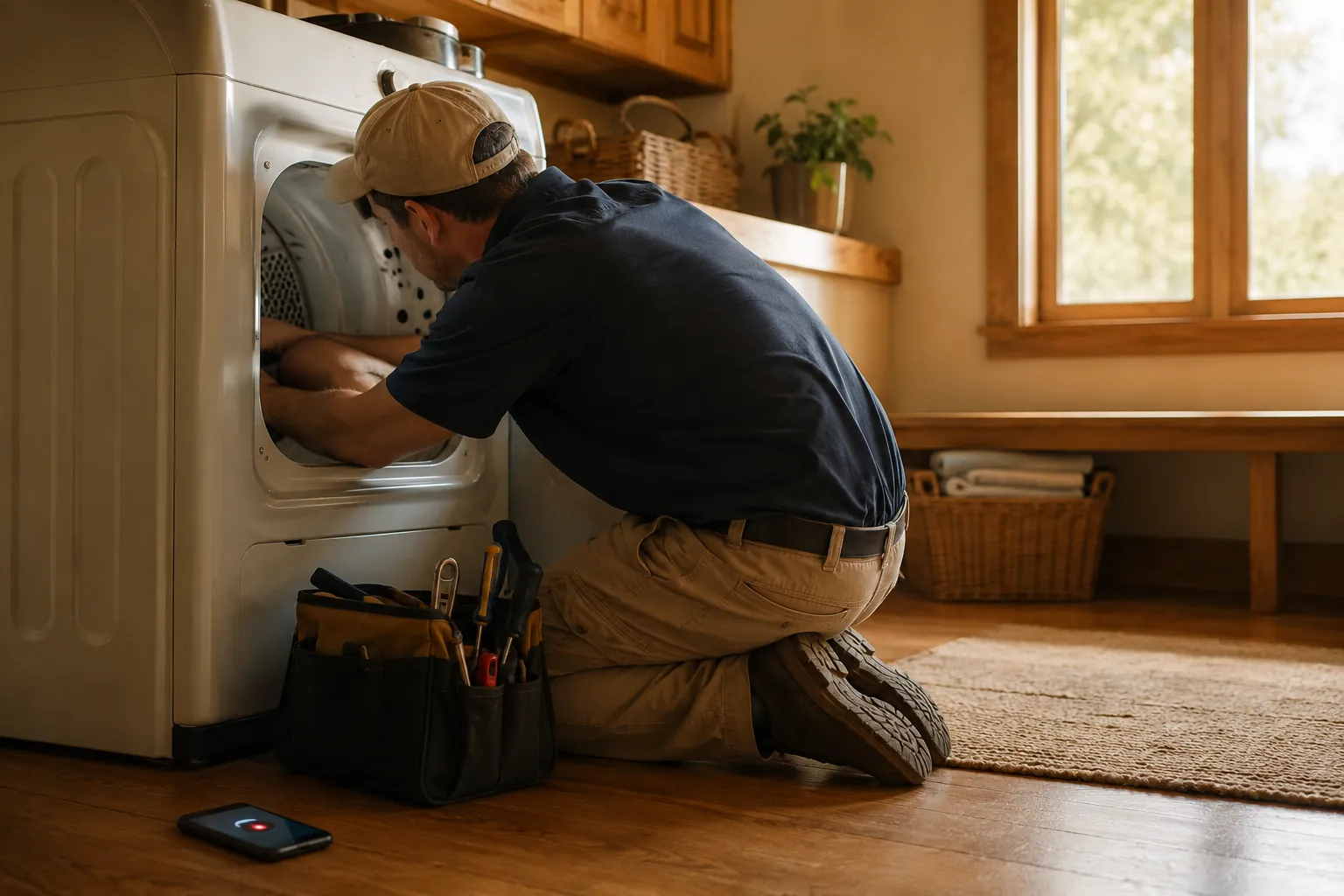
You are on the kitchen floor with a dryer pulled out from the wall. Both hands are in the back panel, chasing a bad thermal fuse. The phone buzzes on the counter. You cannot get up. You cannot wipe your hands fast enough. So it rings out, and you tell yourself you will call back the moment you finish.
By the time you do, the dryer is back together and the caller has booked someone else. That is the whole trap in one moment. Not price. Not skill. You lost the job because you were doing a job.
Why one set of hands is the real problem
In a one-man shop you are everything. The tech, the dispatcher, the office, the bookkeeper. The work that pays you is the work that takes both hands and your full attention. The phone always rings during that work, because that is exactly when you are out earning.
Eugene is a working appliance tech who blogs as Lorainfurniture. He put the math at its bluntest. “Number one drawback of being a servicer,” he wrote, “You don't work, you don't get paid.” No one pays you a salary. The day you answer leads and run calls, you eat. The day the phone slips past you, you do not.
You have lived it this week. You are elbow-deep in a dryer repair and you cannot answer the phone. The moment the work pays you is the same moment it pulls you away from the ring.
What the missed lead actually costs
Here is where it bites. Eugene also laid out his own numbers. “My average ticket is about $225,” he wrote, “with my net profit being around $150 ish.” So a single missed call is not a small thing. It can be a hundred and fifty real dollars walking out the door while you screw a panel back on.
Now look at how the days swing. “Somedays I make $1200, other days I make $0,” Eugene wrote. “this is the nature of the business.” When a slow day can be a zero day, the lead you miss matters a lot. It might have been the one call that made that day pay.
And there is a ceiling on top of it all. “As a servicer,” he wrote, “I just can't see one making more than $120k a year.” That is one owner's estimate, not a law. But if the most a one-man shop can pull is somewhere near that, every lost job is a real cut of a number you cannot grow past by working more hours. You only have so many hours in a day. Adding more of them is not the way out.
The admin you cannot do while you work
It gets tighter. The phone is not the only thing fighting for your hands. “You simply can not work an 8 hour day,” Eugene wrote. “Sure, you can do service calls for 8 hours, but what about scheduling? ordering parts?”
So the day is already overbooked before a single lead comes in. Eight hours of paid work, plus the scheduling, plus the parts orders, plus the quoting. Answering every text and every web form on top of that, in seconds, is not something one person can promise. Something has to give, and usually it is the lead you never saw.
This is the part that traps people. Hustling harder on the phone between jobs will not fix it. You are already maxed. What fixes it is taking the inbound off your plate, so the call landing at 11 a.m. on a busy Tuesday still gets caught.
First to answer takes the job
Most homeowners with a dead fridge do not call one shop and wait. They work down the list until someone picks up. Whoever answers first usually gets the work. The rest never even learn they were in the running.
You have watched it play out. Handle a lead on the first contact and you book most of them. Call them back later and you win far fewer. The call you let go to voicemail is the call your competitor answers.
We dig into the targets in how fast to reply to leads, and the short version is plain. A reply inside a minute wins jobs a same-day callback never sees. When you are the one inside a machine, you cannot win that race alone.
You cannot just hire your way out
The obvious move is to put a person on the phone. For a solo shop, the math rarely works. A live answering service or a front-desk hire is a real monthly bill or a real salary, on jobs where your net per ticket is modest. You would be paying steady money to catch leads that come in bursts.
And paid leads do not solve it either. Kent Berry, who runs KBs Appliance Repair, pays “approximately $30 for each solid lead” from a lead platform. That can work as a channel. But buying more leads when you still cannot answer them just wastes the money. The new leads leak out the same hole as the old ones. We weigh that trade in paid leads versus the leads you own.
Is an AI receptionist worth it vs an answering service?
A live answering service for a one-man shop can run $200 to $400 a month, and it still only takes a message. It cannot tell a brand from a model number or size up whether a lead is urgent. SvarKlar answers in writing instead, asks the appliance questions your shop needs, and books the simple jobs on its own. For the price of a service that just writes down a name, you get one that actually moves the job forward.
Catch the lead without a second person
This is the gap SvarKlar fills. It watches your inbound and answers the moment a lead arrives, while your hands stay on the job. It gives you a second set of hands for the phone without a second person on payroll. That is the job it is built to do, and it can do it for your shop.
- Texts back the calls you miss. The caller you could not reach gets a real text in seconds, not a callback hours later.
- Answers texts, web forms, and direct messages 24/7. The lead from your website or a text never sits waiting for you to be free.
- Asks the right questions. Brand, model, what is wrong, how urgent, so you are not starting from cold.
- Books the simple ones. A clear job goes on the calendar without you touching it.
- Hands you the hard ones. Anything urgent or unclear comes straight to you with the full story already gathered.
Here is what it is: SvarKlar replies to your text, web-form, and message leads, and it texts back the callers you miss. It catches the lead in writing, in seconds, then either books it or escalates it to you. For the wider picture of how that works, see the AI receptionist and how SvarKlar works.
Where this matters most
The leads that hurt the worst to miss are the after-hours ones. A fridge full of meat at 9 p.m. A washer leaking onto a hardwood floor on a Saturday. Those are urgent, well-paying jobs, and they land when no one is near the phone. SvarKlar is already awake for them, so they stop slipping to voicemail. We cover that case in after-hours emergency leads.
The same goes for the calls that land mid-job, the ones this whole trap is built on. When your hands are full, the reply still goes out. More on that in missed calls while you are on the job and on getting the brand, model, and warranty captured clean in capture the brand, model, and warranty up front.
Built by one person, for a one-person shop
There is no bloated platform to fight with here, and no six-month rollout. Fred sets up SvarKlar for your shop himself, and he is the one who runs it. It tracks how appliance work actually goes: the questions you ask, the jobs you book on sight, the ones you want flagged. One person stays on the hook for it, not a faceless platform that signs you up and goes quiet.
If your week looks like the dryer on the floor and the phone you cannot reach, you have read the trap. The fix is not in your hands. It is in catching the lead whether or not you are free to catch it.
You have one pair of hands and one set of hours. The work that pays you takes both, so the phone will always ring at the worst moment. Go back to that kitchen floor, hands in the dryer, phone buzzing on the counter. The job you want is making that buzz turn into a booked call without you getting up.
Want to see how SvarKlar would catch your inbound on a busy day? Book a call or see how the service works.
More guides like this are collected in appliance repair resources.