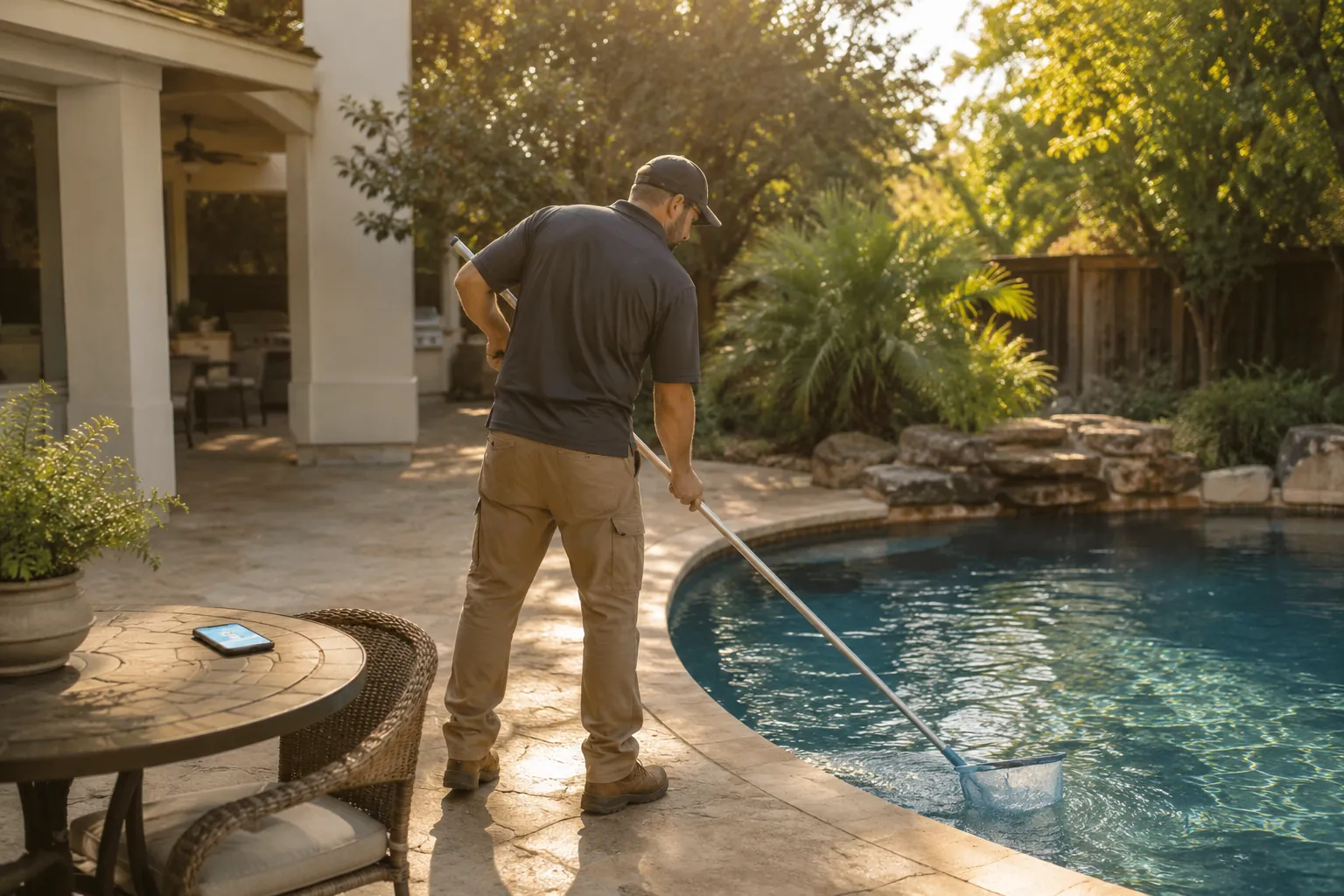
You are at the third pool of the day, net in hand, when your pocket buzzes. It is a customer asking if you can swing by an extra time before a weekend party. You cannot stop and tap out a reply, so you tell yourself you will get to it after the route. By the time you do, it is 6 PM and you are wiped.
That little text matters more than it looks. In pool service, being the person who answers is not a nicety. It is the whole reason your customers stay.
Why pool customers are loyal in the first place
Tim Ryan runs a pool care company in Texas. He put the loyalty plainly on the Owned & Operated podcast: "people are weirdly loyal to their pool cleaners," he said. "Like they know their name, they go into their backyard. They're like, hi, John, like, how are your kids?"
Think about what that means. You are not a faceless vendor. You have a key to their gate. You are in the backyard every week. A competitor cutting a few dollars a month does not break that bond. Trying to win a customer away from their pool guy on price is like trying to steal them from their hairstylist. The pools on a good route are locked in.
The moat is being reachable
So what actually builds that lock? Ryan named it himself, and it is the heart of this whole thing. The loyalty grows when "the customer can still call your cell phone and get ahold of you," he said. "I think it's when you start, you start losing your moat."
The moat is not chemistry skill or price. It is being the person the customer can reach and get a real answer from. That is worth as much to them as the clean water.
Michael Wagner, who runs Pool Scouts, says the same thing from the operator side. "Consistency and communication are paramount to success in the home service industry," he told Authority Magazine. His teams text the customer when they are on the way, send before and after photos, and share the readings. "We are in constant communication with the customer," he said. The point is to be easy to do business with. Easy means reachable.
Why the moat cracks as you grow
Here is the trap. The very thing that wins customers gets harder to do with every pool you add.
When you had a handful of pools, you could answer your phone between stops. You knew every name. At a full route, the day fills up. A solo operator runs a full day of stops with no front desk and no backup. You cannot take a call while you are scrubbing a green pool or pulling apart a pump motor. The texts pile up. The web leads sit.
A serious solo route can run to dozens of pools with barely any help. That is a lot of customers, all expecting the same easy access they had when the shop was tiny.
And the customer feels the change before you do. Homeowners everywhere ask the same question. Why does no one ever return a call or a voicemail? Even pros admit that on a busy day a vague voicemail just gets deleted, never returned. That is not a bad person. That is a busy one. But the customer does not see the difference. They just see that you went quiet. We cover that trap in the voicemail guaranteed-delete problem.
What going quiet costs you
The slow drift looks small day to day. It adds up to churn. Grow fast and you feel it. Even a strong operator loses a chunk of new customers in a fast-growth year. The lesson holds. Growth without staying reachable leaks customers out the back.
And every leak hurts more in this trade than most. The math is thin to begin with. You cannot charge a pool customer enough to cover what the skilled work is really worth. The money is in keeping the recurring account for years, not in the single visit.
Put a number on one lost pool. A steady account is worth a little every month, for years. Lose it and you are not out one month. You are out all the years that customer would have stayed, plus the repairs and extras that come with the relationship. The new lead that never got a reply is the same story in reverse. Most callers who cannot reach you will not try again. They simply book with whoever answers next. The call you miss is the customer your competitor catches.
You cannot just answer more yourself
The obvious fix is to answer everything. You already tried. That is the after-route hour you spend texting people back, the buzzing phone you ignore mid-clean, the Sunday you lose to the inbox.
The cost vs hiring front-desk help
Hiring a front desk does not pencil out at most route sizes. A full-time person is a real salary on a thin-margin business, plus payroll taxes and the weeks they take off. A plain answering service is a stranger who does not know your customers or your chemistry, and still bills you every month whether the call was real or not. SvarKlar runs a fraction of either cost, with no salary and no per-call bill stacking up. Neither a hire nor a live service keeps the personal feel that made the moat in the first place. The customer who used to text "you" does not want to text a call center.
So the goal is not more bodies. It is staying reachable at the size you are now, the way you were reachable with just a handful of pools.
How to keep being reachable while the route grows
This is the gap SvarKlar fills. It works in writing, and it works fast. Here is what it does, and what it can do for your shop. It replies to text, web-form, and direct-message leads in seconds, around the clock. And when a customer calls and you cannot answer, it texts that caller right back before they give up.
Then it does the part that keeps the bond intact. It answers in your voice, the way you would. It handles the simple stuff right away, books the visit or sets a clear callback, and hands you the urgent or unclear ones with the full story attached. The green pool before a party, the equipment that just failed, the question only you can answer. Those reach you with context, not a cold voicemail.
The customer never feels you got too big to answer. The text gets a fast reply, same as it did with just a handful of pools. We put real targets on response speed in how fast you really need to reply to a lead, and the short version is that the first useful reply usually wins.
Two other pieces of this fit right alongside it. When you are out on the route and the phone rings, that is its own squeeze, and we cover it in how to answer while you are on the route. And the green-pool emergency before a holiday is the call you least want to drop, which we walk through in catching the green-pool emergency.
Why this is not big software
If you have been burned before by a faceless platform, fair enough. SvarKlar is the opposite of that. Fred builds it for your shop himself, around how you actually book and what you ask each new customer. He runs it and stays on the hook for it. One person who tunes it to your voice, not a company that signs you up and vanishes.
That is the underdog version of staying reachable. If you want the full picture of what it does, start with what an AI receptionist actually does, or see the whole trade in the pool service guides hub.
Is your moat starting to crack?
It probably is if a few of these sound like your week.
- Texts and web leads sit until after the route is done.
- You see missed calls in the morning you never got back to.
- A long-time customer went quiet, then turned out without a word.
- You cannot justify a front desk, but the route keeps growing.
- You are spending your evenings answering messages from the day.
If two or three landed, the leak has already started. The pools are not gone yet. But the easy access that locked them in is slipping, one unanswered text at a time. The fix is not a longer night of catch-up. It is a fast reply going out the second a lead lands, while you stay out on the route.
You spent years earning a route where the pools are locked in. The thing that locked them in was you, on the other end, every time they reached out. SvarKlar is how that answer still goes out at a full route the way it did with a handful of pools, while your hands are in the water.
Want to see how it would keep your customers reachable? Book a call or see how the service works.
More guides like this are collected in SvarKlar Resources.