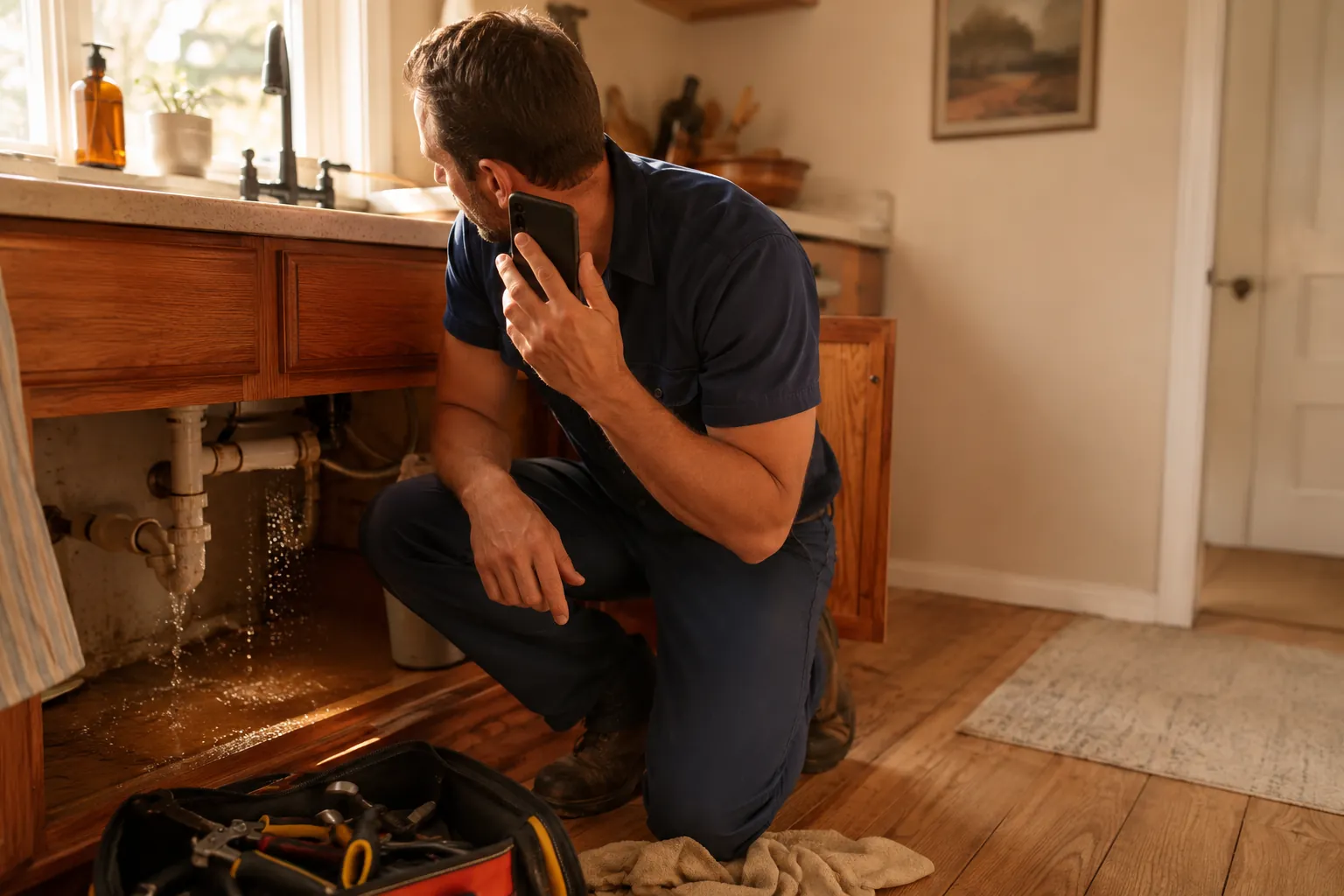
The phone rings while you are wrist deep under a sink. A new caller wants one thing before anything else. How much?
You know the job could be a ten-minute washer or a wall opened up and a section of line replaced. You cannot see any of it from where you stand. So you do the thing every owner learns the hard way to do. You decline to throw out a number.
Then the caller pushes. One owner captured it on the Plumbing Zone forum, exactly the way it sounds in real life: “Somebody called me last week and just kept up with the ‘ballpark’ thing. ‘Just give me a ballpark - I won’t hold you to it.’ Over and over.” You have had that call. Maybe this week.
Why owners refuse to quote sight unseen
The reason is not stubbornness. It is scar tissue. One owner said it straight on the Plumbing Zone forum: “The only price I give over the phone is our hourly rate. I will not give a total price for anything as I have been burnt for that more than once.”
Burnt how? You quote a clean swap, you arrive, and the shutoff is seized, the supply lines are corroded, and the access panel is painted shut. Now the real job is triple the number you said on the phone. The customer heard the first figure and that is the figure they think is fair. You eat the difference or you fight about it on their doorstep.
There is a deeper reason too, and it changes how you handle the call. Another owner on the same Plumbing Zone thread nailed it: “They aren't paying for the price, they are paying for the reassurance that what they are paying is equal to what they are receiving. You can't give them that on the phone.” A number alone does not reassure anyone. Trust does. And trust comes from you standing in their kitchen, naming the problem, and showing them why the price is the price.
What you can say out loud
Refusing a phone quote does not mean refusing to talk price at all. There is a line between a guess and a fact, and a price question really has three paths.
- A published flat rate. Some routine work has a set price you already stand behind, a standard drain clear, a basic water-heater swap. If the job is truly standard, you can name that price on the call.
- A rate or a fee. For anything you have not seen, your hourly rate is a fact and a diagnostic or trip fee is a fact. Say those out loud. The fee also thins out the callers who were never going to book.
- A total for unseen work. This is the guess that comes back to bite you. You do not give a final number for a job you have not looked at.
So the rule is simple. A published flat rate for standard work, yes. Hourly rate, yes. Trip or diagnostic fee, yes. A made-up total for what is behind the wall, no.
The script that books the visit
Forget winning the price argument. The only goal on this call is landing on the calendar. One owner shared the line he uses on Plumbing Zone, and it does exactly that: “When I come out to your home, I can give you an accurate price based on exact needs. You're under no obligation. Let your education and experience do the rest.”
Look at what that does. The owner promises an accurate price, not a refusal. The visit sits at the center of it. “No obligation” takes the pressure off, which is exactly what a nervous caller needs to hear. Then he trusts himself to close in person, where he actually can.
So the call has a simple shape. Acknowledge the price question. Give the one or two real numbers you are willing to give. Then move straight to booking a time to come look. The caller who only wanted a free phone estimate falls away. The caller who has an actual problem books, because you sounded like a pro who knows the job needs eyes on it.
The trap inside the price call
Most owners treat these as two separate headaches. They are not. The price-shopper call and the speed-to-answer problem are the same problem wearing two hats.
A homeowner with a leak does not call one plumber and wait. Miss the call and you lose the lead to whoever picks up. The same is true for the price question. If your line goes to voicemail while they ask how much, they do not leave a message. They call the next name and ask the next plumber.
And the cost of one of those is not small. A price-shopper who would have booked a real visit is money walking to a competitor, every single time you cannot pick up. The full bill for all those skipped calls is its own subject, covered in what missed calls really cost a service business.
This is why a stand-in does not fix it. A spouse or a generic service can answer, but as one owner said on Plumbing Zone of having his wife cover the phone, “she can't quote jobs.” She cannot run the script, give the real rate, hold the line on a phone quote, and steer the caller to a booking. The price call needs someone who knows the answer and the move.
Where SvarKlar fits the price call
You cannot stop a job to run the booking script every time a price-shopper calls. That is the real bind. The call you take from under the sink costs you the customer in front of you. The call you skip costs you the one on the phone.
SvarKlar is the front desk that handles the inbound you cannot. It answers in writing, by text, web-form lead, and direct message, in seconds, around the clock. When a call goes unanswered, it texts that caller right back. So the price-shopper who would have hit voicemail gets a fast, useful answer instead of silence. That is what it does, and it can do it for your shop.
And it can run the line you would run. It can hold the price question the way you do, name your service or diagnostic fee if you set one, and push toward a booked visit instead of a phone quote. Anything urgent or unclear goes straight to you with the full context, so you are never guessing about who texted and why. For the bigger picture on this, see how a fast, useful reply works in our guide to an AI receptionist for service firms and the case for speed in how fast to reply to leads.
One person sets this up, not a faceless platform. Fred builds it around how your shop actually talks to a price-shopper, then runs it himself. It is tuned to your trade, your fee, your booking flow. Not big software you fight with for six months.
Tie it to the rest of your phone problem
The price call is one slice of a wider issue. The same dialer who price-shops you at 2 PM is the one who has a burst pipe at midnight. If you want to fix the whole pattern, not just the quote question, a few of our other plumbing guides go deeper.
For the night-and-weekend version of this, read handling after-hours plumbing calls, where the urgent jobs are and why they vanish to voicemail. For the emergency caller who needs sorting fast, see how to triage plumbing emergencies. And if the real leak is callers hitting your voicemail and not leaving a message, that is its own money pit, covered in the plumber voicemail problem. When the first freeze hits and the phone will not stop, read surviving the cold-snap call surge. The hub for all of it is our plumbing resources.
So the answer holds. Do not quote a whole job over the phone. Give the rate or the fee you are willing to give, then book the visit where you can give an accurate price and earn the trust that closes it. The price question is not a threat to dodge. It is a booking trying to happen.
Ready to hand off the price-shopper calls for good? Book a call, or see how the service works before you do.