
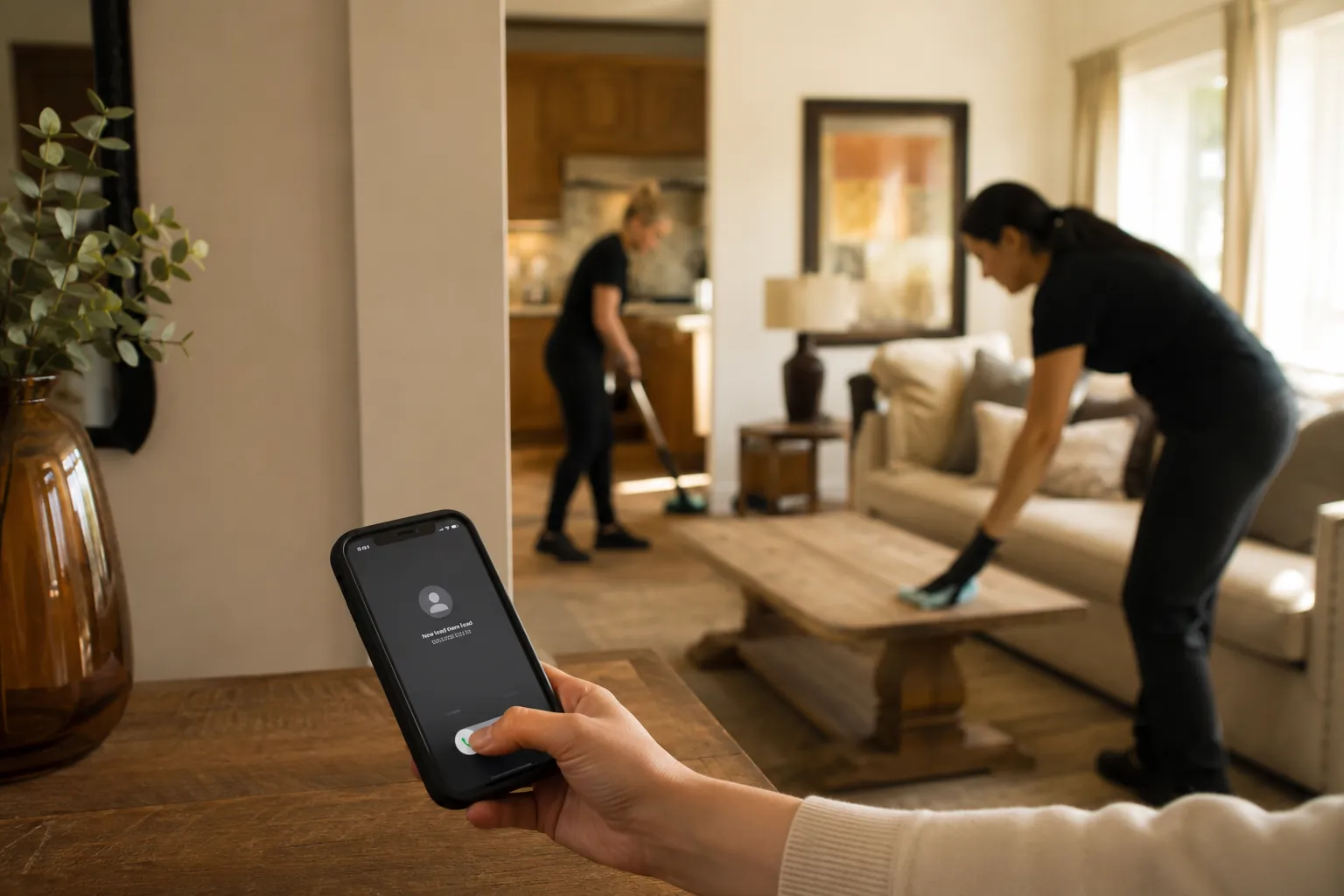
It is 10:30 on a Tuesday. Crew one is in a four-bedroom deep clean across town. Crew two is finishing a move-out. Crew three is on a recurring visit, halfway up the stairs with a vacuum. The company phone buzzes on your desk, or in the van cup holder. A new number.
Nobody on that call list is free. The cleaners cannot drop a client's bathroom to talk pricing, and you are the one driving between jobs. It rings out. The caller has already moved on to the next name by the time you are parked.
When every cleaner is inside a house
A one-person cleaner misses calls because she is busy. A company with crews misses them for a different reason: the phone belongs to no one. There is no front desk, so the call lands on whoever is nearest, and that person is on a job.
Some owners hand the company number to a crew lead. That works until the lead is mid-clean in a client's kitchen with the client watching. Others forward it to their own cell and answer between stops, which means taking a quote call with a vacuum running behind you. Neither gives the caller a clear, calm reply, and neither holds up when you add a third crew.
The more crews you run, the more of the day nobody can pick up. Growth makes the leak bigger, not smaller.
What a busy week does to the phone
Stephanie Pipkin built Serene Clean from a side hustle into a multi-million business. On ZenMaid's Filthy Rich Cleaners podcast (read in June 2026) she put the scale this way: “with 170-180 appointments weekly, we have less than a 1% complaint rate.”
Take the first number and leave the second. A company that books that many visits a week is also fielding a steady stream of new calls, rebooks, reschedules and questions. Each one lands while most of the team is inside a home. You do not need to run 170 visits for this to bite. The pattern is the same at a fraction of that: calls arrive all day, and the people who could answer them are all busy.
We walk through what that adds up to in the true cost of a missed call.
What a missed rebook costs a crew
A solo cleaner who loses a lead loses a job. A crew business loses something else: a filled slot.
A crew is a block of paid hours. Pipkin also said, on another episode, “We are currently at $55 per man-hour.” (ZenMaid, read June 2026.) As an illustration, a crew of three booked for a three-hour clean is nine man-hours, which is $495 at her rate. Use your own numbers, but the shape holds. When a new client or a rebook falls through, the day has a gap, and those hours earn nothing.
A recurring client is worth more than the first visit, because the slot repeats. Cristobal Mondragon, who runs Bumble Bee Cleaning Services, said, “Recurring house cleaning is our bread and butter.” That is the call a crew most needs to catch. A lost recurring lead is not one gap. It is the same gap every other week.
Three kinds of caller, three sets of questions
Crews book three kinds of work, and each starts with a different call.
- Recurring. The caller wants a weekly or every-other-week slot. You need the home size, the frequency, and which days work.
- Move-out. The date is fixed and the home is often empty. You need the size, the move date, and whether it is a deep clean. We cover these in move-out and Airbnb turnover cleans.
- Airbnb turnover. The window between guests is short. You need the unit size, the checkout and check-in times, and how often it will repeat.
A person on a job rarely has the time to ask all of that. A reply that asks the right set for the right kind of caller gets the crew what it needs to schedule.
What happens after the vans are parked
Crews finish in the afternoon. The calls do not stop there. Next week's schedule gets built from the leads that arrive in the evening: the recurring client who wants to move her day, the host who finds out about a Friday checkout.
If those wait for the morning, they wait behind the next day's first calls too. By the time anyone reads them, the crew leads are already out the door, and the reply you send at noon is the third one the lead has received. We cover the timing in how fast to reply to leads.
Who answers while the crews work
SvarKlar answers in the gap. It catches the lead behind every missed call and replies in seconds, whether it comes as a text, a web form, or a social message. When a caller lands on voicemail, it texts that person back before they dial the next company.
It asks what you would ask: the home size, the job type, where it is, and how soon they need it. Then it puts the visit on your calendar, or fixes a time for you to ring the client. Pricing stays with you. It gathers the scope and hands you the details instead of guessing a number on a home it has not seen.
You hear about it on a clean list in the evening, not a missed-call log.
Answering service or text back?
A live answering service picks up for a monthly bill and passes you a message. For a company with crews, that message still waits until you are out of a house. SvarKlar answers the missed call and every text and web lead itself, asks about the home and the job, and books the visit, so nothing sits waiting on a crew lead.
“What if it books a slot my crew cannot staff?”
This is the fear a crew owner has that a solo cleaner does not. A wrong booking does not just disappoint one client. It strands a team on a day that is already full.
That is why the rules you set count for more than the tool. SvarKlar asks the questions your business actually asks, and sticks to what you can deliver, so nobody is promised a crew that is not coming. When the details are unclear or the day looks tight, the lead comes to you with all it gathered, and you decide.
Is this you?
- Every cleaner is inside a house by 9 AM, and the company phone has no owner.
- You have called a client back too late and found out she signed with someone else.
- You can name the recurring slots that sit empty on your schedule.
- Adding a crew has made the phone harder to cover, not easier.
If two of these are true, the answer is not a longer day on the phone. It is a reply that goes out whether or not anyone is free to send it.
Your crews are paid by the hour, so the lead that slips by while they work is the one that costs you the most. SvarKlar texts back the caller you miss, answers the text and the web form, asks the right questions, and books the clean.
Curious what it would do with tomorrow's first new lead, with all your crews out? Book a call or see how the service works.
More guides like this are collected in the house cleaning resource hub, and across SvarKlar Resources.