
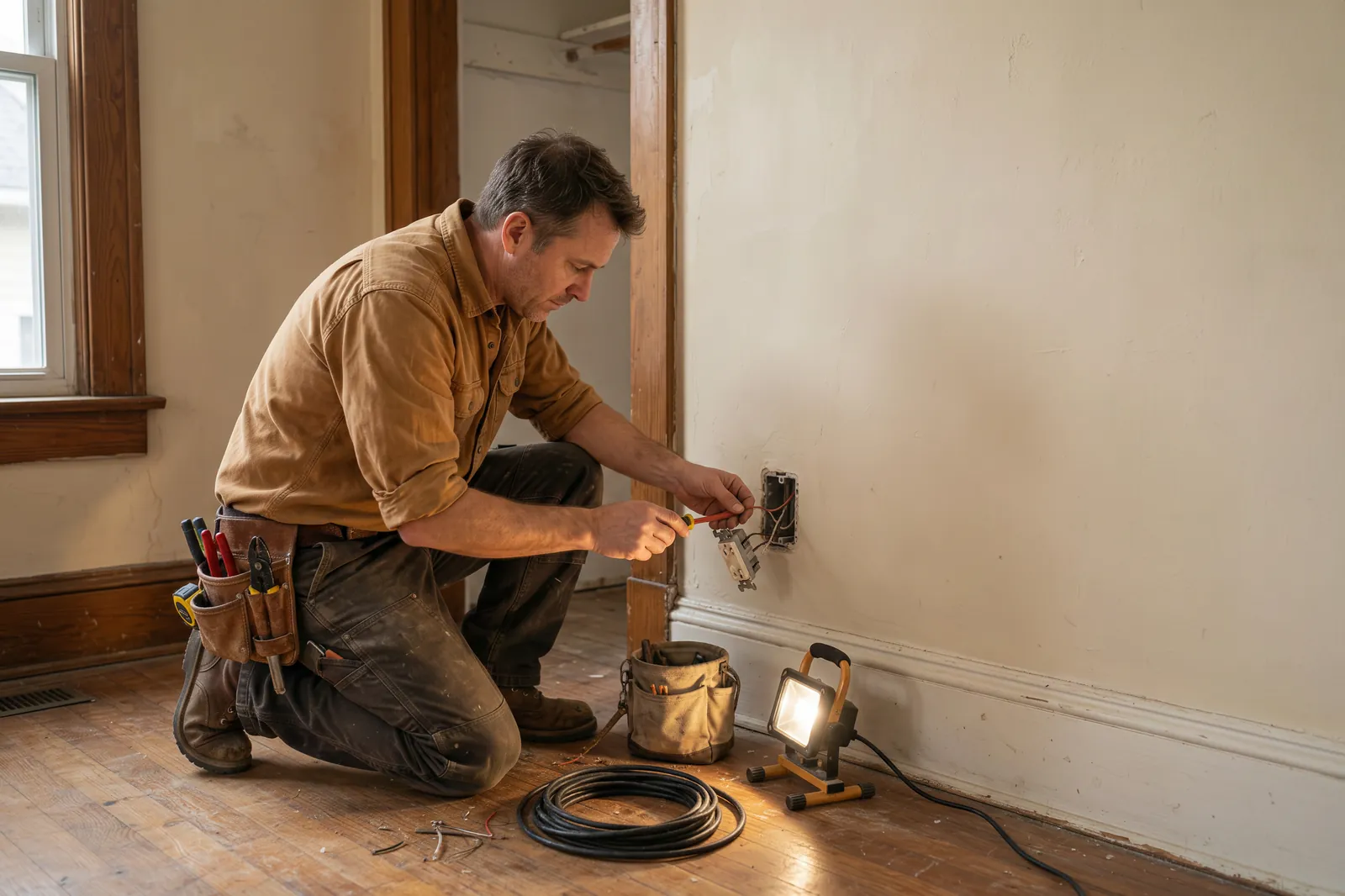
This electrical pricing guide is built around one page you can keep in the van, send to a customer who asks and read from when a call comes in. The sheet covers the repeat work an electrician does every week: outlets, switches, fixtures, a fan, a breaker, a new circuit, a charger outlet, a surge protector and a panel. Whole-house wiring, rewires and new builds are estimates, not lines on a list.
This page and its files are general information, not legal advice. Laws differ by state and change, so check your own state’s current rules before you use the form. Terms for free content.
Electrical pricing guide: how to set every price
This page prints no market price. Labor, rent, insurance and permit costs differ from one shop and one town to the next, so a number from somebody else’s sheet does not fit yours. What follows is the method, in the order you would work it.
Choose how you charge
ServiceTitan, which sells software to trade businesses, describes the two usual ways in its electrical price book guide. For time and materials, “Costs are based on the time spent performing the work and for the materials used in the job.” It defines flat-rate pricing as “A fixed rate for a service.” A price list is the second kind: each line is a fixed price for a named job. The same guide lists the risk for the contractor: “If the job takes longer than estimated, you may end up earning less than your regular hourly rate.” Both read November 23, 2026. So a job goes on the list only when you know how long it takes.
The guide says a full book is a big job, too: “Just putting together such a pricing guide takes hundreds of hours.” That is why this sheet starts with fourteen jobs and eight blank rows, not a binder.
Your cost for one hour
Begin with the wage you pay an electrician for one hour. Each hour also carries payroll taxes, workers’ comp, liability insurance, the van and its fuel, test meters and tools, rent, and the unpaid time on phones, quotes and paperwork. Add a year of that together and divide it by the hours you actually invoice. Driving and supply house runs never reach an invoice, so they lift the cost of each billable hour. A price below that number loses money every time you sell it.
Markup on top of your parts cost
Price each part at what you pay for it today. Then add your markup, so the price covers the trip to the supply house and the part that turns out to be wrong. Markup and margin are different numbers: markup is a percent of your cost, margin is a percent of the price. Work the markup out from the margin you want, and write it on the sheet once, so every price adds the same.
Time each job, then fix the price
Take one line at a time and look back at the last few times you did that job. Write down the hours, the parts and the drive. Use the usual job, never the quickest one. Your hourly cost times the hours, plus parts, plus markup, is the price; round it to a figure that is easy to say on the phone. A price per square foot belongs to a whole-house job, so the sheet has no such line, and wiring a house is an estimate.
Where a fixed price stops
A list suits a job that begins and ends cleanly. When a cover comes off and the wiring is not what you were told, or the customer asks for something you have never wired, the list stops fitting. The printed note sends that job to a written estimate first. Use our electrical estimate template for it, and read how to bid electrical jobs for what to say before you have seen the job.
Keep it current
ServiceTitan says some price books, paper ones too, “fall behind on current equipment costs”. Put a date on the “Prices good until” line. When that day comes, check every price against your latest supply house invoices.
What goes on each line of the price list
Each line of the sheet is below with what to write on it. A state in brackets means a text further down speaks to that line; “ours” means we added the line because the sheet is easier to use with it.
| Field | You write | Why it is there |
|---|---|---|
| Company and license | ||
| Company name, phone, website or email | Typed in, or your logo in the top box | A customer holding the sheet next month can still find you. The Texas text asks for the contractor’s name in advertising (Texas). |
| License, registration or certification number | The number your state gave you | Texts from three states name this number for advertising, and Florida also for an offer of services; each state part below says which paper its text speaks of (California, Texas, Florida). |
| License classification | The class your license covers | A California text speaks of advertising in the classification a person holds (California). |
| Licensing board | Name, phone and website | It tells a customer which office to ask about your license (ours). |
| Common jobs | ||
| Outlets, switches and lights | Outlet, GFCI outlet, switch, dimmer, light fixture, ceiling fan on an existing box, recessed light | These are the questions callers ask weekly, and each gets an answer without a visit (ours). |
| Detector, breaker and circuits | Smoke detector, circuit breaker, new 120 volt circuit, 240 volt or EV charger circuit | Each has a clear start and end when the run is easy to reach. A hard run goes to an estimate (ours). |
| Panel and outdoor work | Whole-house surge protector, service panel, outdoor outlet or light | Panel work shows its surprises late, so the printed note says what happens then (ours). |
| Jobs of your own | Job, what is included, your price, notes | Room for eight jobs that are particular to your shop, with a notes column for limits (ours). |
| Visit fees, rates and markup | ||
| Service call fee, and whether it is credited | The fee, and yes or no | A customer knows before you drive out what the visit costs (ours). |
| Troubleshooting rate, hourly rates | Per hour: troubleshooting, one electrician, electrician and helper | A fault with no known cause has no fixed price, so the hour is priced instead (ours). |
| After-hours rate and start time, weekend and holiday rate | A rate, and the hour it starts | Night and weekend calls cost you more, and the customer reads that before saying yes (ours). |
| Minimum charge | The smallest bill for any visit | Ten minutes of work still costs you the van and the setup (ours). |
| Markup on materials | A percent | Set once, so every price you work out adds the same share (ours). |
| Terms | ||
| The printed note | Already on the form | If the wiring or panel is not what was expected, a written estimate comes first and work waits for the customer’s yes (ours). |
| Prices good until, payment methods | A date, and card, check or other | Parts prices change, and how the customer pays is settled before the first tool comes out (ours). |
| Workmanship warranty, permit and inspection fees | What you cover and for how long; who pulls permits and the fee | Customers ask about both after the job, so put them in writing before it (ours). |
| Materials chosen by, price changes if | You or the customer; a cause you can name | If the customer picks a costlier fixture, the line price moves with the choice (ours). |
An electrical price list and state law: what we found in California, Texas, Florida and New York
The words in quote marks below are copied from the text named, and each is said as the paper it speaks of. We read no text that names an electrician’s price list, and none of the texts says whether a price list counts as advertising or as an offer of services. In another state, or in a town with its own rules, read the source before you use the form.
California, Business and Professions Code
Business and Professions Code section 7030.5 applies to every licensee of the Contractors State License Board. It speaks of contracts, bids and advertising: “Every person licensed pursuant to this chapter shall include his license number in: (a) all construction contracts; (b) subcontracts and calls for bid; and (c) all forms of advertising, as prescribed by the registrar of contractors, used by such a person.” The registrar’s rule on forms of advertising was not read.
Section 7027.1 applies to any advertising for construction work covered by the contractor chapter. Its words are from the state’s own page, checked there November 23, 2026. On advertising, it says it is a misdemeanor “to advertise for construction or work of improvement covered by this chapter unless that person holds a valid license under this chapter in the classification so advertised”. Subsection (b) of the section says what advertising includes; read it there. Section 7027.2 applies when an unlicensed person advertises work under $1,000; read it there.
Texas, Administrative Code
16 Texas Administrative Code section 73.51 applies to any licensed electrical contractor. The state shows the rule’s text as a file its rule site makes on request, and we read that file. On advertising, it says “All advertising by electrical contracting companies designed to solicit electrical business shall include the electrical contractor's name and license number.” It adds: “This includes business cards.” We found no text in the rule on posted or printed prices as such. Whether a posted or handed-out price list is advertising for the rule is the department’s call. The rule also asks for a line on proposals, invoices and written contracts, which we do not quote here; read it there.
Florida, chapter 489
Florida statute 489.521(7) applies when an electrical or alarm system contractor certified or registered under Part II of chapter 489 makes an offer or advertisement. It says “The registration or certification number of a contractor shall be stated in each offer of services, business proposal, or advertisement, regardless of medium, used by that contractor.” The license line on the form is where that number goes. We found no Florida text that names a price list. The Electrical Contractors’ Licensing Board rules, chapter 61G6, were not read.
New York
We found and read no statewide New York rule on an electrician’s price list. Check the state’s and your town’s own rules.
When a caller asks a price and your hands are in a wall
A price list helps only if somebody answers the phone. A homeowner who rings to ask what an outlet costs while you are in an attic gets voicemail, and dials the next electrician. What missed calls really cost puts numbers on that, and why homeowners give up shows how quickly a caller moves on.
A call you miss gets a text from SvarKlar within seconds. It quotes only from your own price list, and only if you want that, so a caller reads the prices from this sheet. A job that is not on it has its details taken and passed to you for the estimate. A caller who describes sparks, smoke or a burning smell is told to get clear and call 911 before any talk of price, once you set your emergency rules. AI receptionist pricing shows what covering the phone costs, and our electrician answering service guide has the rest.
Work out what one hour of your crew costs you before you write a single price. Every line on this sheet is that hour, plus parts, plus the markup you need.
Want to hear what a caller who asks your price would get from SvarKlar? Book a call or see how the service works.