
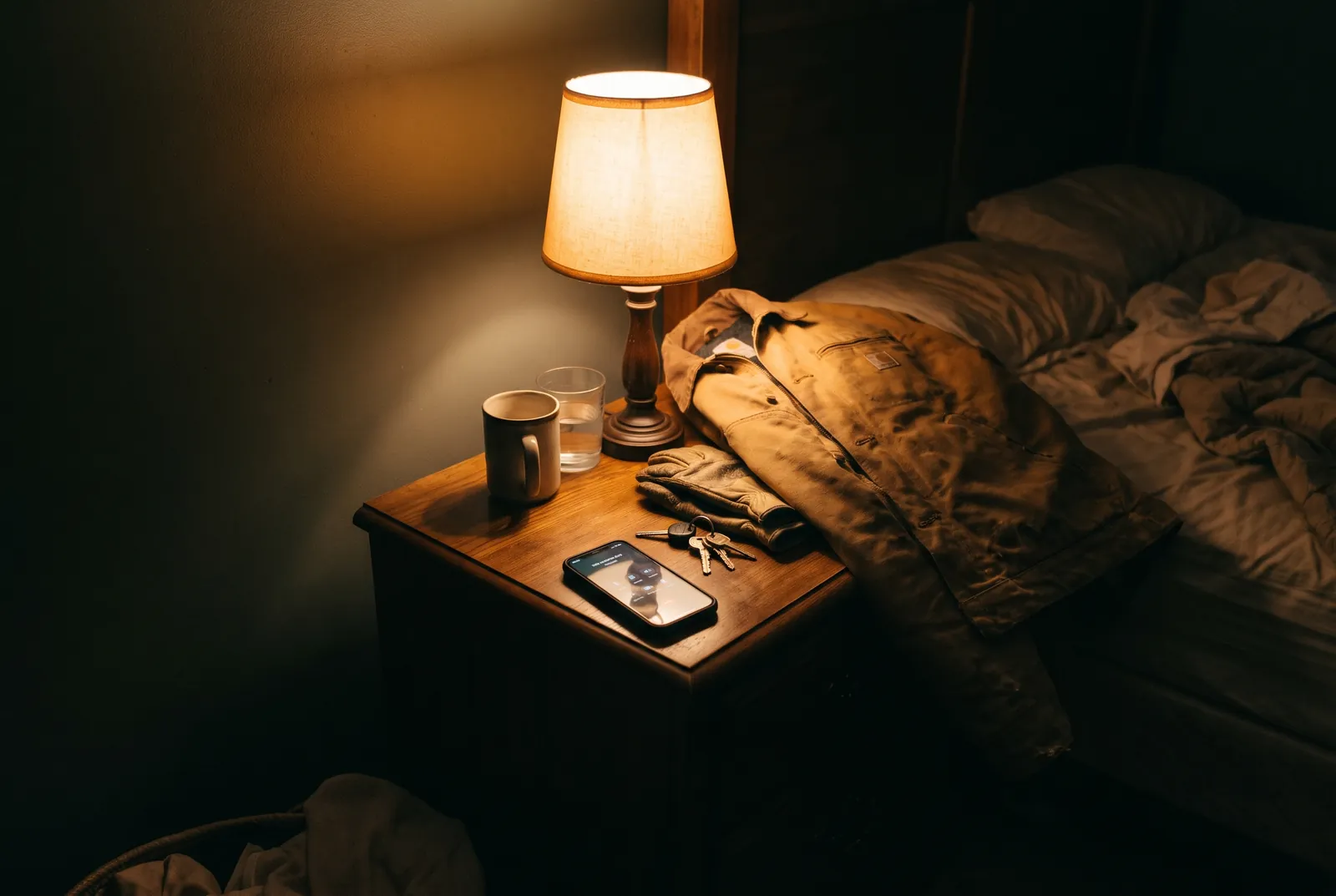
It is 11 PM on a holiday weekend and the phone is ringing. You are asleep, or at dinner, or three hours from home. Some of those calls are a family with a problem that cannot wait. Others are a homeowner who wants a quote and will be fine at 8 AM. The hard part is telling them apart before you pick up. This page covers the sorting, the rules, the hand-off and the prices.
Emergency or morning: sorting the night's calls
Danger comes first, and a repair is second. If a caller describes a gas smell or a carbon monoxide alarm, the first words they hear should tell them to leave the house and call the gas company or 911 from outside. No question about the job comes before that line. The same goes for sparks, smoke or a burning smell: get clear and call 911.
After the safety line, the call is yours to rank. The table below is our view of a sensible split, not a rule from any code or agency, so adjust it to your crew and your area.
| Trade | Get-safe line first | Worth waking someone | Can wait for morning |
|---|---|---|---|
| HVAC | Gas smell or carbon monoxide alarm: leave the house, call the gas company or 911 from outside. | No heat on a cold night, or an AC that quit in a heat wave. Send the address and the unit. | A tune-up request, a quote, a filter question. |
| Plumbing | Shut the main water valve if it is safe to reach. Water near outlets or the panel: stay clear and call the power company. Gas smell near a water heater: leave, call the gas company or 911 from outside. | Water that will not stop, or a sewer line backing up into the house. | A slow drip that a fixture shut-off stops, a price question. |
| Electrical | Sparks, smoke or a burning smell: get clear and call 911. Water near electrics: stay clear, call the power company. | A home or rental with no power after dark, with the address and a callback number. | A new outlet, a quote, work planned for another day. |
| Other trades | Fire or a downed line: get clear, call 911 or the utility. | You decide, trade by trade. Write the list before the night you need it. | Estimates, scheduling, invoice questions. |
The middle column is the one owners argue about. A shop in a mild climate may let a no-AC call wait until six. A shop in July may not. There is no right answer, only the one you commit to in writing.
Writing your emergency rules
Emergency rules are a short list that someone, or something, follows when you are asleep. Keep it short enough to read in a minute. Four parts do most of the work.
- The words that trigger the safety line. Gas, smell, alarm, sparks, smoke, flooding. List the phrases your callers really use.
- What counts as a wake-up call. Your middle column from the table, in your own terms.
- What gets asked, in order. Address first, then the problem, then a callback number. A caller in a panic can answer three questions and not ten.
- What the caller is told will happen. Say "a tech will call you" only when a tech really will. If the honest answer is "we open at 8", say that.
Test the list with a bad night in mind. Ask what happens if two emergencies land at once, or if the caller is a tenant and the landlord pays.
The hand-off to your on-call tech
In our view, the hand-off loses more emergency jobs than the pickup does. The call is taken well, the note goes to a phone that is face down, and the homeowner rings the next shop at 12:30.
Name one on-call person each night, and one backup. Decide how long the first person has to confirm before the backup is tried, and when it falls to you. Agree where the note lands, whether that is a text or a call, because a note in an inbox nobody checks at night is a missed call with extra steps. The note itself should carry the address, the problem in the caller's own words, a callback number and the time it came in.
Then tell the caller the truth about what comes next. Honest beats fast-sounding. A caller told "someone will call within 30 minutes" who gets a call at 90 is angrier than one told "we are looking for a tech and will text you either way".
Four ways to cover the night
Prices checked October 2026 on each company's own pages. Plans change, so get your own quote in writing. Each rival row links to our page on that company, and the AI receptionist pricing page has the wider price picture. Weighing a person against software? Virtual receptionist covers the human plans.
| Option | Who answers at 2 AM | Price read | Source |
|---|---|---|---|
| Your own cell | You, if you wake up and the signal holds. | Nothing added to your phone bill. | None |
| Voicemail | A recording. Callers choose whether to leave a message. | The lowest monthly bill of any row here. | None |
| Ruby | Live receptionists, 24/7/365, holidays included. | $250 a month for 50 minutes up to $1,725 for 500. Live chat is billed separately. | Ruby pricing |
| Smith.ai live | 24/7 live answering, month to month. | $300 a month for 30 calls, $810 for 90, $2,100 for 300. Booking adds $1.50 a call. | Smith.ai live plans |
| Smith.ai AI | An AI voice that answers at any hour. | Free for 25 calls, Pro $150 a month for 75, Enterprise $500 for 300. | Smith.ai AI plans |
| RingCentral AI Receptionist | Answers and routes around the clock, plus a text agent. | $49 a month standalone, or $39 on a separately billed RingEX plan. 100 minutes included, then $0.50 a minute. | RingCentral AIR pricing |
| SvarKlar | Answers calls, and replies to missed calls, texts and web forms within seconds. | $295 a month. Setup free. Cancel any time. | Book a call |
In our view, your own cell is a fine first layer and a poor only layer. It holds as long as one person is rested, in range and willing, every night of the year, Christmas included.
A made-up example
This is a made-up example, not a forecast. Say a shop gets 12 after-hours calls in a month, about 3 minutes each, so 36 minutes in all. Swap in the real count from your phone log.
- Ruby at $250. 36 minutes fits inside the 50-minute plan. The month works out to about $21 a call.
- Smith.ai live at $300. 12 calls fits inside the 30-call block, so about $25 a call. Unused calls in the block are still paid for.
- Smith.ai AI Pro at $150. 12 calls fits inside 75, about $12.50 a call. The free tier covers 25 calls at $0.
- RingCentral standalone at $49. 36 minutes is under the 100 included, so about $4 a call.
These are not like for like. A live person and an AI do different jobs, and calls and minutes are different units. The sum shows only what the same month looks like through each meter. Then weigh each figure against what one saved emergency job brings in, using the missed call calculator.
SvarKlar at night
We make SvarKlar, so weigh this section with that in mind. Frederik, the founder, sets up your rules and runs the account himself. When a call goes unanswered, a text goes back to the caller within seconds, and texts and web forms get a reply the same way. The reply collects the address and the problem, then books the visit or sets a callback. You choose whether replies send on their own or wait for your okay. If a customer asks, it says it is an AI.
Once you have set your emergency rules in the Portal, the reply to a gas smell or a carbon monoxide alarm opens with the get-safe line, and the questions come after it. Emergencies and odd cases go to you, not to a guess. SvarKlar does not dispatch, so someone on your side still sends the tech. It is not a person on a headset, either: an AI answers the call, and a caller it misses gets a text back within seconds.
What to ask before you buy
- The first words a caller hears on a gas smell or a carbon monoxide alarm, written down.
- How an emergency reaches your on-call tech, and what the service does when that person does not answer.
- Whether nights, weekends and holidays cost the same as a Tuesday morning.
- What happens at the plan's limit, whether minutes or calls.
- How you stop the plan, and what you pay for the rest of the month.
Before you sign, ring your own number at 11 PM from a phone that is not yours. Read what arrives on your side the next morning.
Questions
Do I have to wake up for every night call?
No. That is what the emergency rules are for. The emergency pile reaches you or your on-call tech, and the rest waits until morning with a booked visit or a callback.
A caller says water is near the electrical panel. What do they hear first?
The get-safe line: stay clear of the wet equipment and call the power company. Only after that do the questions start. If your service cannot show you that wording in writing, keep looking.
What if my on-call tech does not pick up?
Write down a backup person and a time limit before the first night, then ask any provider how it supports that order. If it only sends one text to one phone, the gap stays yours.
Is my own cell enough?
It is enough while you are the only one who needs to hear the phone and you are always awake for it. Once you take a holiday, get sick or sleep through a ring, a second layer pays for itself.
Think about last Saturday's 11 PM call and who really saw it. SvarKlar is built for that gap. $295 a month. Setup free. Cancel any time. Book a call to get started or see all comparisons.
Sources
- Ruby plans and pricing, checked October 2026
- Ruby live receptionists, checked October 2026
- Smith.ai live receptionist plans, checked October 2026
- Smith.ai AI receptionist plans, checked October 2026
- RingCentral AI Receptionist pricing, checked October 2026